
Kharg Island’s history extends far beyond its modern role as Iran’s principal crude-oil export terminal. Archaeological remains reveal centuries of settlement, religious activity and maritime trade, while more recent history reflects the island’s transformation into one of the Persian Gulf’s most strategically important energy hubs.
This timeline traces Kharg Island’s development from ancient settlement and medieval trade through foreign occupations, petroleum expansion, the Iran–Iraq War and its present-day role in global energy and maritime affairs.
Ancient and Late Antique Settlement
Rock-cut tombs, burial chambers, religious structures and other archaeological remains demonstrate that Kharg Island supported communities long before the development of its modern oil industry.
Some tombs display architectural and artistic influences associated with ancient trade routes linking Mesopotamia, Iran, Arabia and the eastern Mediterranean. Other burial areas have been connected with Zoroastrian, Jewish and Christian communities, although the precise dates and identities associated with individual sites continue to be studied.
7th–9th Centuries — Christian Monastic Community
A large Christian monastic complex operated on Kharg Island during the early Islamic period, possibly beginning as early as the seventh century.
Archaeologists identified a church, monks’ cells, a library, a refectory and other communal buildings. The complex is among the most significant examples of early Christian archaeology discovered in the Persian Gulf region.
Circa 982 — Kharg Mentioned for Its Pearls
The anonymous Persian geographic work Hudud al-Alam, composed around 982, described Kharg as a source of high-quality pearls.
The island also served as a stopping point for merchant vessels traveling between India and the port of Basra. Pearling, trade, gardening and maritime services supported the local economy.
1218 — Visit by Geographer Yaqut al-Hamawi
The geographer and writer Yaqut al-Hamawi visited Kharg in 1218. Accounts associated with this period describe an island connected to regional trade, pearl fishing, fruit cultivation and date-palm agriculture.
1337–1339 — Shrine Inscriptions
Inscriptions dated to 1337 and 1339 appear at the tomb and shrine traditionally associated with Muhammad ibn al-Hanafiyya.
The shrine’s construction may be connected with the rulers of Hormuz, who controlled important commercial routes through the Persian Gulf during the medieval period.
Trade and Foreign Competition
1645 — Dutch Sailors Call the Island “Delft”
A small Dutch fleet traveling toward Basra stopped at Kharg to obtain a maritime pilot. Dutch sailors referred to the island as “Delft,” after the Dutch city associated with one of the Dutch East India Company’s offices.
1665 — Jean de Thévenot Visits Kharg
French traveler Jean de Thévenot visited Kharg and documented its commercial connections with Basra, Bandar Rig and Isfahan.
He also noted the presence of qanats, underground channels traditionally used to collect and transport water.
1753–1754 — Dutch East India Company Establishes a Base
Dutch East India Company representative Baron Tiddo Frederik van Kniphausen obtained control of Kharg and attempted to develop it as a free port open to international trade.
The Dutch built houses and Fort Mosselstein in the northeastern part of the island. Armenian traders and European soldiers became part of the growing settlement.
1757 — Catholic Church Completed
A Catholic church was completed during the Dutch occupation. A Carmelite priest served the island’s Christian population, and the Roman Catholic Bishop of Isfahan reportedly moved his residence to Kharg for a period.
1759–1763 — Conflict Over Dutch Control
Tensions between the Dutch settlement and the regional ruler Mir Muhanna developed into open hostilities.
An attack against the Dutch fort in 1762 was repelled, and a temporary truce allowed trade to resume the following year.
January 1, 1766 — Dutch Occupation Ends
After a ten-day siege, Mir Muhanna captured Fort Mosselstein and forced the Dutch from Kharg. The fall of the fort ended approximately twelve years of Dutch occupation.
1769 — Kharg Returns to Persian Control
Mir Muhanna was forced to leave Kharg in January 1769. The island was taken in the name of Karim Khan Zand, and a Persian garrison was installed.
A later British East India Company attempt to capture the island was repelled.
Nineteenth-Century Occupations
1807 — Proposed French Control
A commercial agreement connected with the Treaty of Finkenstein proposed transferring Kharg to France in exchange for French assistance to Persia.
The arrangement was never implemented and was later abandoned.
1837 — First British Occupation
British forces briefly occupied Kharg as part of an effort to pressure Persia during the conflict over Herat. Persian forces later returned to the island.
December 1856 — Second British Occupation
British forces seized Kharg again during the Anglo-Persian War. The occupation was connected to another dispute over Persian military operations around Herat.
Late 1800s — Return to Traditional Industries
After the period of foreign occupations, many island residents returned to traditional activities such as pearl fishing, maritime pilotage, gardening and regional trade.
Transformation into an Oil Export Hub
1956 — Construction of Oil Storage Begins
Work began on reservoirs intended to store crude oil transported from the Gachsaran oil fields on the Iranian mainland.
This development marked the beginning of Kharg Island’s transformation from a small maritime community into a major petroleum-export center.
Late 1950s — Mainland Pipeline Connections Expand
Pipelines connected mainland oil-producing regions with Kharg Island. Crude oil could then be stored in tank farms and transferred to visiting tankers.
Additional pipelines, storage tanks, piers and loading equipment followed as export volumes increased.
Early 1960s — Kharg Emerges as Iran’s Principal Oil Terminal
The expanding terminal became Iran’s primary outlet for crude-oil exports. Its location and surrounding deep water allowed it to accommodate tankers that could not easily use shallower mainland ports.
1969 — Petrochemical Facility Established
A petrochemical facility was established as a joint venture involving the National Iranian Oil Company and the American Oil Company, commonly known as Amoco.
The complex handled products including sulfur, liquefied petroleum gas and other petroleum-related exports.
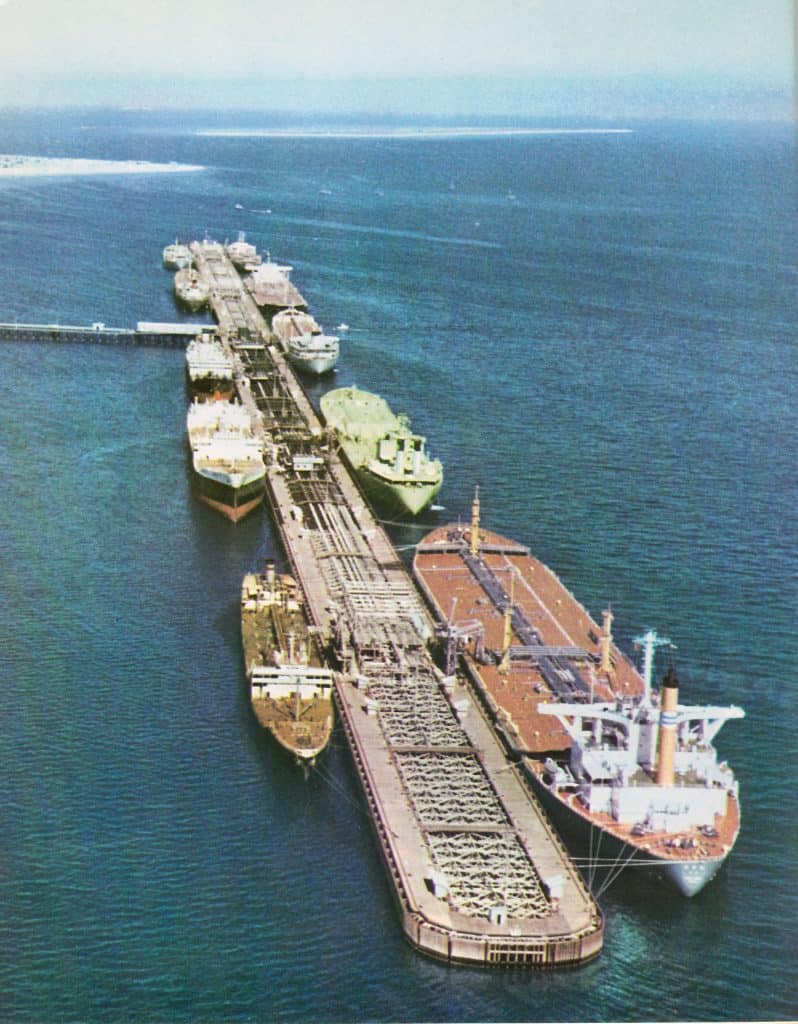
1973 — Sea Island Terminal Constructed
An offshore loading platform known as the Sea Island terminal was constructed more than one kilometer from the island’s shore.
The terminal’s deep-water berths were designed to serve exceptionally large tankers, including vessels of up to approximately 500,000 deadweight tons.
Mid-1970s — Multiple Marine Terminals Operate
By the middle of the decade, Kharg’s major facilities included the Kharg Terminal, Sea Island Terminal, Darius Terminal and the Kharg Chemical Complex terminal.
Together, these facilities could accommodate several tanker classes and handle crude oil, liquefied gas, sulfur and other petroleum products.
Late 1970s — One of the World’s Largest Oil Complexes
By the end of the 1970s, Kharg Island’s petroleum collection, storage and export infrastructure ranked among the largest in the world.
The island handled multiple Iranian crude streams delivered from both mainland and offshore fields.
The Iran–Iraq War
September 1980 — War Begins
Iraq invaded Iran in September 1980, beginning an eight-year conflict. Because petroleum exports supplied essential revenue to Iran, Kharg Island quickly became an important military and economic target.
Early 1980s — Initial Attacks on Oil Infrastructure
Iraqi aircraft began attacking petroleum facilities, tankers and shipping connected with Kharg Island.
Iran repaired damage, dispersed equipment and adjusted loading procedures in an effort to keep oil exports moving.
1984 — The Tanker War Intensifies
Attacks on commercial shipping and petroleum infrastructure expanded during the phase commonly known as the Tanker War.
Tankers operating near Kharg faced increasing danger, while shipping companies and insurers had to account for the possibility of aerial attack.
1985–1986 — Repeated Air Raids
Iraq intensified its campaign against Kharg Island’s storage tanks, loading berths and related infrastructure.
Iran used shuttle tankers, offshore storage and alternative loading locations to reduce its dependence on direct visits by foreign tankers.
1986 — Sirri Island Used as an Alternative
Iran increasingly moved crude from Kharg to Sirri Island, farther south in the Persian Gulf, where it could be transferred to international buyers.
Iraq subsequently expanded its attacks to alternative Iranian petroleum facilities.
August 1988 — War Ends
The Iran–Iraq War ended after causing extensive damage across the region.
Kharg Island’s facilities had sustained repeated attacks, but the terminal continued operating during much of the conflict and remained central to Iran’s oil-export system.
Reconstruction and Modernization
Late 1980s–1990s — Postwar Repairs
Iran began repairing damaged storage tanks, pipelines, jetties and loading equipment after the war.
Reconstruction restored Kharg Island’s position as the country’s principal crude-oil export terminal.
2000s — Terminal Upgrades Continue
Modernization projects increased reliability and maintained the island’s ability to handle large crude carriers.
Kharg remained connected to several mainland and offshore petroleum fields through an extensive pipeline network.
2009 — Major Export Activity Recorded
Iran reported substantial crude-oil export and swap activity through the southern Kharg terminal during 2009, illustrating the island’s continuing dominance within the country’s petroleum-export network.
2015–2016 — Exports Rise Following the Nuclear Agreement
After implementation of the international nuclear agreement and the easing of some sanctions, Iranian crude production and exports increased sharply.
Kharg Island served as the principal loading point for much of the additional export volume.
May 2018 — United States Withdraws from the Nuclear Agreement
The United States withdrew from the Joint Comprehensive Plan of Action and began reimposing sanctions on Iran’s petroleum sector.
Iranian oil exports subsequently declined, and the destination and movement of some tanker cargoes became increasingly difficult to verify.
May 2019 — Oil Sanction Waivers Expire
U.S. waivers allowing several countries to purchase Iranian petroleum expired in May 2019.
Iranian crude shipping increasingly involved indirect routing, ship-to-ship transfers, intermittent vessel-identification signals and other practices that complicated public export estimates.
July 2021 — Jask Export Route Opens
Iran shipped an initial cargo through the Jask terminal and Goreh–Jask pipeline east of the Strait of Hormuz.
The project was intended to provide an alternative export route, although Kharg Island continued to serve as Iran’s principal crude-oil terminal.
2022–2025 — Estimated Exports Increase
Tanker-tracking estimates published by the U.S. Energy Information Administration indicate that Iran’s crude-oil and condensate exports increased between 2022 and 2025.
The exact volume moving through any individual terminal remains difficult to determine because of limited public information and efforts to obscure some vessel movements.
Kharg Island in 2026
March 13–14, 2026 — Military Sites Struck
United States forces conducted strikes against military targets on Kharg Island. U.S. Central Command stated that more than 90 military targets were struck while the island’s oil infrastructure was preserved.
The event brought renewed international attention to Kharg Island’s importance and the possible consequences that disruption of its petroleum facilities could have for Iran and global energy markets.
Because events surrounding Kharg Island can change rapidly, current developments should be confirmed through multiple reliable sources.
Kharg Island Today
Kharg Island remains Iran’s principal crude-oil export terminal and one of the most closely monitored energy locations in the Persian Gulf.
Its significance rests on the combination of deep-water tanker access, pipeline connections, extensive storage capacity, marine loading facilities and proximity to the Strait of Hormuz.
The island’s history demonstrates how a small landmass can become important to archaeology, religion, maritime trade, warfare, international politics and global energy security.
Continue Exploring
- History of Kharg Island
- Oil Export Terminal
- Iran–Iraq War and Kharg Island
- Strategic Importance
- Shipping and Tanker Traffic
- Satellite Imagery
Sources and Further Reading
- Encyclopaedia Iranica — Kharg Island: History and Archaeology
- Encyclopaedia Iranica — Kharg Island: Developments Since the 1950s
- U.S. Energy Information Administration — Iran Energy Overview
- U.S. Energy Information Administration — Report on Iranian Petroleum Exports
- CIA Reading Room — Kharg Island: Iran’s Principal Oil Export Terminal
- CIA Reading Room — The Iran–Iraq War: Oil Vulnerability Issues
- Reuters — U.S. Strikes Military Targets on Kharg Island