
Kharg Island became one of the most heavily contested economic targets of the Iran-Iraq War. As Iran’s principal oil-export terminal, the island provided revenue that helped sustain the country throughout the eight-year conflict.
Iraq repeatedly attacked Kharg’s storage tanks, loading facilities, support infrastructure, and nearby shipping. Iran responded by repairing damage, dispersing exports, using alternative terminals, and maintaining operations whenever possible. The struggle surrounding Kharg eventually became part of the wider maritime conflict known as the Tanker War.
Why Kharg Island Became a Target
When Iraq invaded Iran in September 1980, petroleum exports were vital to both countries. Oil sales generated foreign currency needed to support government operations, purchase equipment, and finance the war.
Kharg Island was especially important because it handled most of Iran’s crude-oil exports. Pipelines transported oil from producing regions to the island, where it entered storage tanks before being loaded aboard tankers.
This made Kharg an attractive strategic target. If Iraq could disable the terminal, it could potentially:
- Reduce Iran’s petroleum revenue
- Create excess oil inventories inside Iran
- Force production cuts at connected fields
- Interrupt shipments to international buyers
- Increase shipping and insurance costs
- Weaken Iran’s ability to finance the war
Kharg’s industrial concentration made it efficient during peacetime but vulnerable during sustained aerial attack.
Kharg Island at the Beginning of the War
By 1980, Kharg had become a major petroleum-export complex with storage tanks, pipelines, pumping equipment, conventional tanker berths, and offshore loading facilities.
The terminal had been designed to serve large vessels and move several million barrels of crude oil per day under favorable operating conditions. Its established pipeline connections and deep surrounding water made it difficult to replace with another Iranian port.
Although Iran possessed other terminals, none initially offered the same combination of capacity, infrastructure, and access to mainland oil production.
Iraqi Air Attacks on Kharg
Iraq began sustained attacks against Kharg Island during the early years of the war. The intensity increased as Iraq attempted to damage Iran’s petroleum industry and reduce the flow of oil revenue.
Aircraft attacked storage tanks, loading facilities, pipelines, and ships operating near the island. Exact raid totals differ among historical sources because attacks were counted and classified in different ways.
Encyclopaedia Iranica reports that Kharg was raided 44 times between August and November 1985 alone. By 1986, repeated attacks had severely damaged or disabled much of the terminal’s original infrastructure.
Even when individual strikes caused limited physical damage, they could still disrupt operations by forcing tankers to wait, leave the area, or reconsider future voyages.
The Tanker War
The maritime campaign associated with the Iran-Iraq War became widely known as the Tanker War.
Iraq attacked ships serving Iranian ports in an effort to reduce Iran’s oil exports. Iran retaliated against vessels associated with Iraq’s supporters and other shipping in the Persian Gulf.
Commercial tankers increasingly faced:
- Air and missile attacks
- Naval mines
- Vessel seizures and inspections
- Damage to terminals and loading areas
- Rising insurance costs
- Uncertainty about safe shipping routes
The attacks expanded the conflict beyond Iran and Iraq. Tankers, crews, cargo owners, insurers, and governments from numerous countries became exposed to the war’s risks.
Tankers Traveling to and From Kharg
Ships approaching Kharg Island became targets because attacking tankers could disrupt exports without completely destroying the terminal.
Tankers were vulnerable while traveling through the Gulf, waiting near the island, maneuvering toward a berth, or loading petroleum. An attack could damage a vessel, delay other ships, and discourage tanker owners from accepting future cargoes.
In March 1985, the tanker Neptune was sunk while traveling empty toward Kharg Island. The U.S. Naval History and Heritage Command identifies it as the first tanker sunk during the conflict, although numerous other commercial vessels had already been attacked or damaged.
Actual sinkings remained less common than attacks and damage, but the threat affected the entire shipping system supporting Iranian exports.
How Iran Kept Oil Moving
Iran used several methods to preserve exports despite attacks on Kharg.
Emergency Repairs
Damaged pipes, tanks, loading equipment, and support systems were repaired whenever conditions allowed. Restoring even part of the terminal’s capacity helped Iran continue generating export revenue.
Dispersed Storage
Iran reduced its dependence on individual storage tanks by changing how oil was held and moved. Dispersal made it more difficult for one attack to eliminate a large share of available exports.
Shuttle Operations
Smaller or more expendable vessels could move crude away from Kharg to other loading areas. This reduced the need for large international tankers to remain close to the island’s most frequently attacked facilities.
Alternative Terminals
Iran increasingly relied on facilities at Sirri, Larak, and other locations farther south and east in the Persian Gulf. These alternatives allowed some exports to continue when Kharg was heavily damaged or considered too dangerous.
Reduced and Flexible Loading
Terminal operators adapted loading schedules and used facilities that remained operational. Kharg did not need to function at full design capacity to remain economically valuable.
These measures did not eliminate the effects of Iraqi attacks, but they made it more difficult to stop Iranian exports completely.
Sirri and Larak as Alternative Export Points
As the pressure on Kharg increased, Iran developed or expanded alternative export arrangements at Sirri and Larak islands.
Oil could be transported away from Kharg or routed through other facilities before being transferred to international tankers. Moving loading activity farther from Iraq increased the distance Iraqi aircraft had to travel.
However, these alternatives had limitations:
- Lower capacity than Kharg
- Fewer established facilities
- Longer internal transportation routes
- Dependence on shuttle tankers
- Continued vulnerability to long-range attacks
- Additional cost and operational complexity
Iraq eventually extended attacks to alternative Iranian export locations, demonstrating how the struggle over oil infrastructure spread across the Persian Gulf.
The 1985–1986 Escalation
Attacks on Kharg became particularly intense during 1985 and 1986.
During this period, Iraq sought to inflict enough damage to overwhelm Iran’s ability to repair the terminal. Storage tanks burned, loading facilities were damaged, and tanker operations became increasingly dangerous.
By the latter part of 1986, much of Kharg’s original terminal capacity had been placed out of commission or severely constrained. Iran continued exporting oil, but it relied more heavily on improvised arrangements, alternative facilities, and reduced operations.
The inability of repeated attacks to eliminate Iranian exports entirely demonstrated the resilience of Iran’s petroleum network. It also showed that disabling a complex system required more than damaging a few visible structures.
International Involvement in the Persian Gulf
The Tanker War drew outside powers more directly into Gulf security.
Kuwait sought protection for tankers carrying its oil, leading the United States to reflag and escort selected vessels under Operation Earnest Will beginning in 1987. Other countries also deployed naval forces or increased their presence to protect shipping and monitor the conflict.
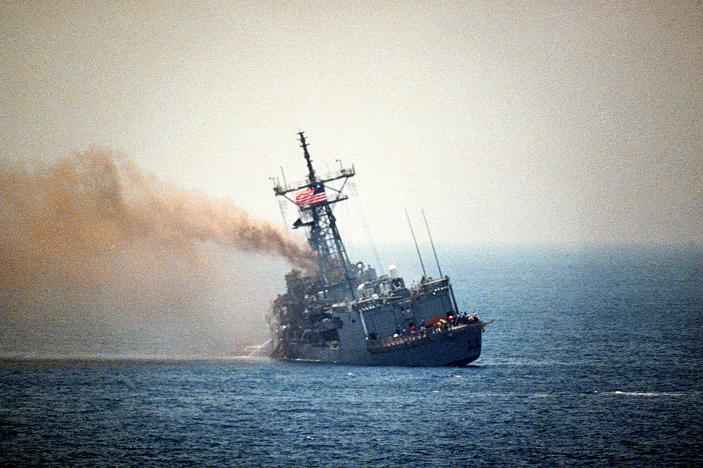
The United States and Iran became involved in several confrontations, including mine incidents and attacks on naval and petroleum-related targets. In April 1988, the United States launched Operation Praying Mantis after the frigate USS Samuel B. Roberts struck an Iranian mine.
These events did not occur at Kharg itself, but they grew from the broader maritime conflict created partly by attacks on oil exports and shipping connected to Kharg and other Gulf terminals.
Economic Effects of the Attacks
The attacks placed considerable pressure on Iran, but their effects went beyond lost barrels of oil.
The campaign produced:
- Repair and reconstruction expenses
- Reduced loading capacity
- Tanker delays
- Higher freight and insurance rates
- Increased reliance on shuttle operations
- More complicated export logistics
- Periodic production and storage constraints
- Greater uncertainty for international buyers
Oil revenue continued to reach Iran, but exporting crude became more difficult, expensive, and dangerous.
The Tanker War also influenced international petroleum markets. Traders monitored attacks, shipping activity, and the possibility of a wider interruption in the Strait of Hormuz.
Environmental and Human Consequences
The conflict affected more than infrastructure and government revenue.
Attacks on tankers and terminals caused fires, oil releases, and marine pollution. Damaged ships placed crews at risk, while smoke and burning petroleum threatened personnel working around terminal facilities.
The Persian Gulf is a relatively enclosed body of water. Oil pollution can affect fisheries, coastlines, wildlife, desalination facilities, and communities far beyond the original location of a spill.
Civilian mariners from many countries were exposed to danger even though their nations were not direct participants in the Iran-Iraq War.
Kharg After the Ceasefire
Iran and Iraq accepted a ceasefire in August 1988. Kharg Island emerged from the war with extensive damage to its petroleum infrastructure.
Repairs and reconstruction continued after the fighting ended. Iran restored loading facilities, replaced damaged equipment, rebuilt storage capacity, and later upgraded portions of the terminal.
Kharg ultimately regained its position as Iran’s principal crude-oil export hub. Its restoration reflected the island’s continuing economic importance and the difficulty of replacing its pipeline connections, deepwater access, and established facilities.
Lessons From Kharg Island’s Wartime Experience
Kharg’s experience during the Iran-Iraq War illustrates several enduring lessons about energy infrastructure:
- Concentrated infrastructure can be both efficient and vulnerable.
- Physical damage does not always produce a complete shutdown.
- Repair capacity and operational flexibility improve resilience.
- Alternative terminals can reduce—but not eliminate—dependence on a primary hub.
- Attacks on energy infrastructure can internationalize a regional conflict.
- Commercial shipping may become a strategic target during wartime.
- Environmental and economic effects can extend far beyond the battlefield.
The wartime struggle over Kharg helps explain why the island remains closely monitored whenever tensions rise in the Persian Gulf.
Iran-Iraq War Timeline
| Period | Development |
|---|---|
| September 1980 | Iraq invades Iran, beginning the Iran-Iraq War |
| Early 1980s | Iraq begins targeting Iranian petroleum and export infrastructure |
| 1982–1984 | Attacks on Kharg and Gulf shipping increase |
| 1984 | The maritime campaign becomes widely known as the Tanker War |
| March 1985 | The tanker Neptune is sunk while traveling toward Kharg |
| August–November 1985 | Encyclopaedia Iranica records 44 Iraqi raids on Kharg |
| 1986 | Heavy attacks severely reduce Kharg’s original operating capacity |
| 1986–1987 | Iran relies more heavily on Sirri, Larak, shuttle tankers and improvised facilities |
| 1987 | Operation Earnest Will begins escorting reflagged Kuwaiti tankers |
| April 1988 | The United States conducts Operation Praying Mantis |
| August 1988 | Iran-Iraq ceasefire takes effect |
| Postwar period | Kharg’s terminal infrastructure is repaired, restored and expanded |
Sources and Further Reading
- Encyclopaedia Iranica — Kharg Island: Developments Since the 1950s
- U.S. Naval History and Heritage Command — The Tanker War
- U.S. Naval History and Heritage Command — Operation Praying Mantis
- CIA Reading Room — The Iran-Iraq War: Oil Vulnerability Issues
- CIA Reading Room — Kharg Island: Iran’s Principal Oil Export Terminal
- U.S. Energy Information Administration — Iran Background