
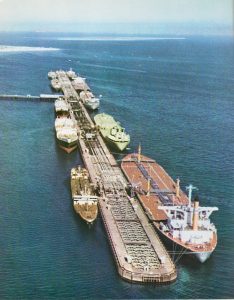
Kharg Island is the location of Iran’s largest and most important crude-oil export terminal. Its pipelines, storage tanks, loading berths, and deepwater facilities connect Iranian oil fields with tankers serving international markets.
Although Iran operates other petroleum terminals, Kharg has historically handled the majority—and frequently an estimated 90 percent—of the country’s crude-oil exports. This concentration makes the terminal essential to Iran’s petroleum industry and a closely watched component of global energy infrastructure.
What Is the Kharg Island Oil Terminal?
The Kharg Island Oil Terminal is a large petroleum storage and loading complex in the northern Persian Gulf. Crude oil produced in mainland and offshore fields is transported to the island through pipelines, held in storage tanks, and transferred to tankers for export.
The terminal is operated through Iran’s state petroleum system. The Iranian Oil Terminals Company, a subsidiary of the National Iranian Oil Company, oversees operations at Kharg and other Iranian oil terminals.
Kharg’s facilities are designed to manage several stages of the export process:
- Receiving crude oil through pipelines
- Separating and managing different crude-oil blends
- Storing oil before export
- Coordinating tanker arrivals
- Transferring crude through loading arms and marine pipelines
- Measuring and documenting outgoing cargoes
- Maintaining port and marine-support operations
This infrastructure allows oil produced far inland to enter international maritime trade through one central export location.
| Quick fact | Information |
|---|---|
| Location | Kharg Island, northern Persian Gulf |
| Country | Iran |
| Primary function | Crude-oil storage and export |
| Operator | Iranian Oil Terminals Company |
| Parent organization | National Iranian Oil Company |
| Main facilities | Storage tanks, pipelines, tanker berths and offshore loading facilities |
| Major export streams | Iran Light, Iran Heavy and Foroozan Blend |
| Historic export share | Majority of Iranian crude exports; frequently estimated near 90% |
| Main shipping route | Persian Gulf through the Strait of Hormuz |
Why the Terminal Was Built on Kharg Island
Kharg Island’s natural geography made it an attractive location for a major oil terminal.
Much of Iran’s Persian Gulf coastline is relatively shallow. The deeper water surrounding Kharg can more easily accommodate large tankers, including very large crude carriers. Offshore loading facilities can serve vessels that require considerable water depth when fully loaded.
The island is also positioned near producing regions in southwestern Iran and several offshore petroleum fields. Pipelines connect the terminal with oil-producing areas, allowing crude to be transported directly to storage and loading facilities.
Kharg combines four important advantages:
- Deepwater access for large tankers
- Proximity to Iranian oil-producing regions
- Space for storage tanks and industrial facilities
- Access to major Persian Gulf shipping routes
Together, these features enabled Kharg to become Iran’s principal crude-oil export hub.
How Oil Moves Through Kharg Island
The export process begins at oil fields on the Iranian mainland or offshore in the Persian Gulf. Crude oil enters a network of gathering lines and transmission pipelines that carry it toward Kharg Island.
Once it reaches the terminal, the oil may be stored until a tanker and export cargo are ready. Storage capacity allows terminal operators to manage differences between continuous oil production and changing tanker schedules.
When a vessel arrives, crude is pumped from storage through the terminal’s transfer system and into the tanker. Larger vessels may load at offshore facilities constructed in deeper water.
A simplified version of the process is:
- Crude oil is produced in mainland or offshore fields.
- Pipelines transport it to Kharg Island.
- Oil is directed into storage tanks.
- A tanker is assigned a berth or loading position.
- Crude is pumped through marine loading equipment.
- The tanker departs through the Persian Gulf.
The exact flow depends on the crude grade, operating conditions, available berths, storage levels, and vessel requirements.
Main Terminal Facilities
Kharg’s petroleum complex includes several interconnected types of infrastructure.
Storage Tanks
Large storage tanks allow crude oil to accumulate before it is loaded aboard ships. Storage helps maintain exports when production and tanker schedules do not align perfectly.
Published estimates of Kharg’s total storage capacity vary by source and period. The differences may reflect facility expansions, operational status, and whether certain tanks or related storage areas are included.
Eastern Loading Facilities
The main terminal facilities along the island’s eastern side include multiple berths used to load tankers. The eastern location provides access to sheltered waters within the Persian Gulf.
Infrastructure upgrades have changed the number of vessels that can be served over time, so present-day operational capacity may differ from older published specifications.
Sea Island Terminal
Kharg also includes an offshore loading facility often called the Sea Island Terminal. It was constructed in deeper water to accommodate very large tankers that could not efficiently use shallower berths.
The U.S. Energy Information Administration has described Kharg as including a main terminal and a four-berth sea island, although the number of operational berths has varied.
Pipelines and Pumping Systems
Submarine and mainland pipeline connections carry crude to the island. Pumping stations, valves, manifolds, and transfer lines direct oil between incoming pipelines, storage tanks, and marine loading facilities.
Together, these systems form an integrated network rather than a single dock or loading point.
Crude-Oil Blends Handled at Kharg
Kharg handles oil originating from both onshore and offshore production.
The U.S. Energy Information Administration has identified the terminal with major Iranian export streams including:
- Iran Heavy
- Iran Light
- Foroozan Blend
Iran Heavy and Iran Light generally include crude produced from fields on the mainland, while Foroozan Blend is associated with offshore production.
Keeping crude streams properly managed is important because different grades have different density, sulfur content, and refining characteristics. Buyers select grades based on refinery capabilities, economics, and the petroleum products they intend to produce.
Development of the Terminal
Kharg Island’s transformation into an oil-export center began during the mid-20th century.
Early development connected mainland oil fields with the island through pipelines running by way of Iran’s coast. Additional pipelines, tanks, piers, and loading berths were constructed as Iranian production and tanker sizes increased.
A broad timeline includes:
- 1950s: Pipeline and terminal development begins.
- 1960: Kharg’s first major oil-loading facilities enter operation.
- 1960s: Additional pipelines and storage capacity support increasing exports.
- 1970s: Offshore loading facilities are developed for larger tankers.
- 1980s: The terminal is repeatedly attacked during the Iran-Iraq War.
- Postwar period: Damaged infrastructure is repaired and export operations are restored.
- 21st century: Kharg remains Iran’s principal crude-export terminal while facilities continue to be maintained and upgraded.
The terminal’s development reflects broader changes in the petroleum industry, especially the arrival of larger tankers and the growing scale of international oil trade.
The Iran-Iraq War and the Tanker War
Kharg Island became a major target during the Iran-Iraq War of 1980–1988. Iraqi aircraft repeatedly attacked the terminal, storage areas, tankers, and related infrastructure in an effort to reduce Iran’s petroleum exports and weaken its economy.
The maritime phase of the conflict became known as the Tanker War. Commercial vessels and energy facilities across the Persian Gulf faced attacks, mining, and other hazards.
Despite extensive damage and repeated disruption, Iran continued using Kharg during much of the conflict. Repairs, alternate loading arrangements, and other measures helped preserve at least part of the country’s export capability.
This period demonstrated both the terminal’s vulnerability and its extraordinary economic importance.
Kharg’s Role in Iranian Oil Exports
Kharg remains Iran’s dominant crude-oil export location. The exact percentage handled by the terminal changes with production, sanctions, maintenance, shipping patterns, and the use of alternative terminals.
The U.S. Energy Information Administration has described Kharg as Iran’s largest export terminal and the departure point for most Iranian crude. More recent government and international reporting has continued to identify it as the terminal through which the majority of Iran’s exported oil flows.
Other Iranian terminals include facilities at Lavan Island, Sirri Island, and Jask. However, none has historically matched Kharg’s combination of pipeline connections, storage infrastructure, loading capacity, and central role in Iran’s oil-export system.
Why Disruption at Kharg Matters
A serious interruption at Kharg could affect several connected systems:
- Iranian crude-oil exports
- Tanker availability and scheduling
- Oil storage levels inside Iran
- Production at connected oil fields
- Government petroleum revenue
- Regional shipping and insurance costs
- International oil prices and market expectations
Not every interruption would produce the same outcome. The effect would depend on its duration, the condition of pipelines and loading facilities, available storage, tanker access, and Iran’s ability to redirect shipments through other terminals.
Because so much infrastructure is concentrated at Kharg, energy analysts often describe the island as a potential bottleneck or single point of vulnerability within Iran’s export system.
Kharg Island and the Strait of Hormuz
Tankers departing Kharg normally travel through the Persian Gulf and pass through the Strait of Hormuz before reaching the Gulf of Oman and wider international shipping routes.
The Strait of Hormuz is one of the world’s most important petroleum transit corridors. This means Kharg’s export operations are connected to a second strategic chokepoint: even if the terminal operates normally, disruptions to navigation through the strait can affect tanker movements and delivery schedules.
Iran developed the Jask terminal on the Gulf of Oman partly to create an export route located outside the Strait of Hormuz. However, Kharg remains the center of Iran’s established crude-export network.
Why the Terminal Is Closely Watched
Governments, energy companies, tanker operators, insurers, commodity traders, and security analysts monitor Kharg Island because changes there may offer clues about Iranian exports and broader regional conditions.
Analysts commonly watch:
- Tanker arrivals and departures
- Visible storage-tank levels
- Loading activity
- Pipeline interruptions
- Maintenance and construction
- Shipping restrictions
- Regional military developments
- Sanctions affecting vessels and buyers
Public assessments may rely on satellite imagery, vessel-location signals, customs information, commercial shipping data, and statements from governments or energy organizations.
These methods provide useful estimates, but reporting about exact exports, storage levels, and operating capacity can differ between sources.
Sources and Further Reading
- U.S. Energy Information Administration — Iran Background
- Encyclopaedia Iranica — Kharg Island: Developments Since the 1950s
- U.S. Treasury — Iranian Oil Terminals Company and Kharg Island
- U.S. Energy Information Administration — Strait of Hormuz