
Kharg Island’s strategic importance comes from the concentration of energy infrastructure, maritime access, and national economic interests within one small area of the Persian Gulf.
The island serves as Iran’s principal crude-oil export hub and has historically handled the majority of the country’s oil shipments. Its deepwater facilities, pipeline connections, storage tanks, and tanker berths make Kharg essential to Iran’s petroleum industry—and significant to governments, shipping companies, energy traders, and security analysts around the world.
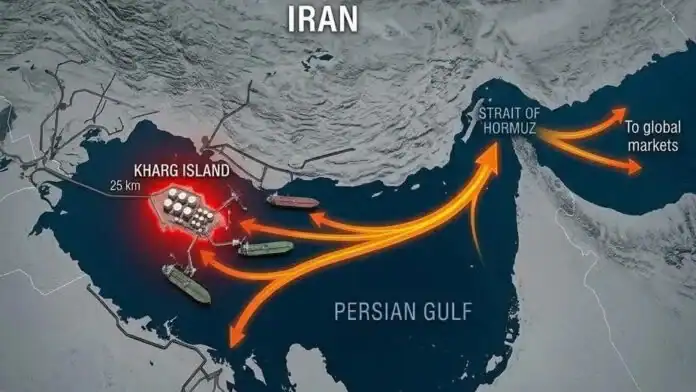
A Small Island With an Outsized Role
Kharg Island covers only about eight square miles, yet its economic importance is far greater than its physical size suggests.
Most islands become strategically important because of their location. Kharg combines location with extensive industrial infrastructure. Oil produced across southwestern Iran and from offshore fields can be transported to the island, stored, blended, and loaded aboard tankers for international shipment.
This concentration gives Kharg several overlapping roles:
- Iran’s principal crude-oil export hub
- A link between Iranian oil fields and international markets
- A deepwater loading location for large tankers
- An important source of petroleum-export revenue
- A closely monitored site during periods of regional tension
- A potential bottleneck within Iran’s energy system
Few individual locations are as closely connected to Iran’s ability to export crude oil.
Importance to Iran’s Economy
Petroleum exports have long been an important source of foreign currency and government revenue for Iran. Kharg Island provides the infrastructure that allows much of that oil to reach overseas buyers.
The terminal’s economic importance extends beyond the value of individual shipments. Export revenue can influence government spending, currency reserves, trade balances, industrial investment, and Iran’s ability to purchase goods from international suppliers.
A prolonged disruption at Kharg could create several economic pressures:
- Reduced petroleum-export revenue
- Growing oil inventories inside Iran
- Pressure to slow production at connected fields
- Difficulty fulfilling export commitments
- Increased transportation and insurance costs
- Greater reliance on smaller or less efficient terminals
For these reasons, Kharg is frequently described as an economic lifeline for Iran.
Importance to Global Energy Markets
Iran is a major petroleum producer, and changes in its export capacity can influence international oil markets. Because Kharg handles such a large share of Iranian crude shipments, developments involving the island can affect expectations about global supply.
Oil markets often react before physical supplies are actually interrupted. Reports of terminal damage, tanker delays, pipeline problems, military escalation, or restrictions on shipping can create uncertainty among traders and refiners.
The international impact of a disruption would depend on:
- How long the interruption lasts
- The amount of Iranian oil removed from the market
- Available production from other countries
- Global petroleum inventories
- Tanker availability
- Conditions in the Strait of Hormuz
- The ability to redirect exports through other Iranian terminals
Kharg does not control the global oil market by itself. However, its central role in Iranian exports makes it one of several energy locations capable of influencing prices and supply expectations.
A Concentrated Energy Bottleneck
Kharg’s strength is also a source of vulnerability. Pipelines, tanks, pumping systems, loading berths, and support facilities are concentrated within a relatively small geographic area.
This concentration creates efficiency during normal operations. Oil from multiple producing regions can be gathered, stored, and exported through one established network. At the same time, dependence on one primary hub means a serious interruption could affect a substantial portion of Iran’s export system.
Energy analysts often use the term chokepoint or single point of vulnerability to describe infrastructure whose disruption could affect a much larger network.
Kharg is not a maritime chokepoint in the same way as the Strait of Hormuz. Ships are not required to sail past the island to cross the Persian Gulf. Instead, Kharg is an infrastructure bottleneck because so much Iranian crude is routed through its terminal system.
Connection to the Strait of Hormuz
Kharg Island lies inside the Persian Gulf. Tankers departing the island normally must pass through the Strait of Hormuz before reaching the Gulf of Oman, Arabian Sea, and wider international shipping network.
This creates two connected points of strategic importance:
- Oil must reach and be loaded at Kharg Island.
- Tankers must be able to navigate through the Strait of Hormuz.
The U.S. Energy Information Administration has described the Strait of Hormuz as one of the world’s most important oil transit chokepoints. Large volumes of petroleum from Iran, Saudi Arabia, Iraq, Kuwait, the United Arab Emirates, Qatar, and other producers have historically passed through the waterway.
A disruption at either Kharg or the strait can therefore affect Iranian exports. A broader interruption in the Strait of Hormuz may also influence energy shipments from multiple Persian Gulf countries.
Deepwater Access and Large Tankers
The water surrounding much of Iran’s Gulf coastline is relatively shallow. Kharg’s deeper approaches allow specialized facilities to serve large crude carriers that require substantial water depth when fully loaded.
Large tankers provide economies of scale by transporting enormous quantities of oil in a single voyage. Accommodating these vessels helps reduce the transportation cost per barrel and supports long-distance shipments to Asian and other international markets.
Kharg’s deepwater access is therefore more than a geographic convenience. It is one of the fundamental reasons the island became Iran’s primary export center.
Maritime and Shipping Importance
Kharg sits within a maritime region containing tanker routes, offshore oil fields, ports, pipelines, and naval activity.
Commercial operations around the island require coordination among:
- Tanker owners and operators
- Terminal authorities
- Harbor and marine-support services
- Pilots and tug operators
- Petroleum producers
- Exporters and buyers
- Maritime insurers
- Safety and environmental personnel
Shipping companies monitor Kharg because terminal conditions can affect loading schedules, voyage planning, vessel availability, and insurance expenses.
During periods of heightened tension, ships may face increased operating costs, additional inspections, changing routes, unavailable tracking data, or difficulty obtaining insurance coverage.
Strategic Importance During the Iran-Iraq War
Kharg Island’s importance was demonstrated during the Iran-Iraq War of 1980–1988.
Iraqi forces repeatedly attacked the island, tankers, and related energy infrastructure in an attempt to reduce Iranian oil exports. These attacks formed part of the broader maritime conflict known as the Tanker War.
Iran repaired damaged facilities, adjusted export operations, and continued shipping oil during much of the conflict. Kharg’s continued operation was essential to sustaining petroleum revenue during the war.
The experience demonstrated three enduring characteristics of the island:
- Its importance made it a prominent target.
- Its concentration of infrastructure created vulnerability.
- Iran considered maintaining its operation a national priority.
Sanctions and Geopolitical Pressure
Iran’s petroleum industry has been subject to extensive international sanctions. These measures may affect buyers, banks, tanker owners, insurers, brokers, terminal operators, and companies involved in transporting Iranian oil.
Sanctions do not change Kharg’s physical location or infrastructure, but they influence how its oil reaches international markets. Shipping patterns can become more complicated, and analysts may have difficulty determining the destination, ownership, or commercial arrangements associated with individual cargoes.
Kharg is therefore monitored not only as an industrial facility but also as part of the international effort to understand and enforce restrictions involving Iranian petroleum trade.
Alternative Iranian Export Terminals
Iran operates additional petroleum terminals, including facilities at Lavan Island, Sirri Island, and Jask.
The Jask terminal is particularly notable because it is located on the Gulf of Oman, outside the Strait of Hormuz. Iran developed a pipeline and export facility there to create an alternative route that could bypass the strait.
However, alternative terminals have not historically replaced Kharg’s combination of:
- Pipeline connections
- Storage capacity
- Loading infrastructure
- Deepwater access
- Established operating network
- Proximity to major producing regions
Alternative routes may provide flexibility, but Kharg remains the center of Iran’s crude-oil export system.
Environmental Importance
The concentration of petroleum infrastructure also creates environmental risk. Oil spills, pipeline leaks, fires, equipment failures, or damage to loading facilities could affect coastal waters and marine ecosystems.
Environmental consequences would depend on the location and size of a release, weather conditions, currents, and the speed of containment efforts.
Because the Persian Gulf is relatively enclosed and supports fisheries, coastal communities, shipping, and desalination systems, a significant petroleum incident could have effects extending beyond Kharg Island.
Why Governments and Analysts Monitor Kharg
Kharg Island attracts attention from several different groups for different reasons:
| Observer | Primary interest |
|---|---|
| Iranian government | Export capacity, revenue and energy security |
| Oil-importing countries | Reliability of petroleum supplies |
| Energy traders | Changes in supply and price risk |
| Tanker operators | Loading conditions, routes and vessel safety |
| Maritime insurers | Operational and geopolitical exposure |
| Governments | Sanctions, regional security and economic pressure |
| Environmental organizations | Spill and marine-pollution risks |
| Researchers | Infrastructure, shipping and geopolitical trends |
No single indicator provides a complete picture. Analysts combine vessel movements, satellite imagery, official statements, commercial data, customs information, and reporting from multiple sources.
Why Kharg Island Matters Beyond Iran
Kharg Island’s strategic importance extends beyond Iranian territory because energy infrastructure connects producers, shipping routes, refiners, governments, and consumers across the world.
A tanker loaded at Kharg may carry oil to a refinery thousands of miles away. Changes in exports can influence shipping demand, refinery purchasing, commodity prices, government revenue, and diplomatic calculations.
Kharg’s significance can ultimately be summarized through four connected roles:
- Economic: It supports a major source of Iranian export revenue.
- Energy: It connects Iranian production with international petroleum markets.
- Maritime: It serves large tankers operating through the Persian Gulf.
- Geopolitical: Its condition can influence regional security and global market expectations.
This combination makes Kharg Island one of the most consequential pieces of energy infrastructure in the Middle East.
Quick Facts
| Strategic factor | Significance |
|---|---|
| Primary role | Iran’s principal crude-oil export hub |
| Historic export share | Majority of Iranian crude exports; frequently estimated near 90% |
| Economic importance | Supports petroleum sales and foreign-currency earnings |
| Geographic advantage | Deepwater access for large tankers |
| Maritime route | Persian Gulf through the Strait of Hormuz |
| Main vulnerability | Concentration of infrastructure in one location |
| Alternative route | Jask terminal on the Gulf of Oman |
| Global relevance | Oil supply, prices, shipping and regional security |
Sources and Further Reading
- U.S. Energy Information Administration — Iran’s Oil Terminals
- U.S. Energy Information Administration — Strait of Hormuz
- Encyclopaedia Iranica — Kharg Island: Developments Since the 1950s
- Council on Foreign Relations — Kharg Island and Iran’s Oil Economy
- U.S. Treasury — Iranian Oil Terminals Company