The Island Everyone Threatens—and No One Can Afford to Destroy
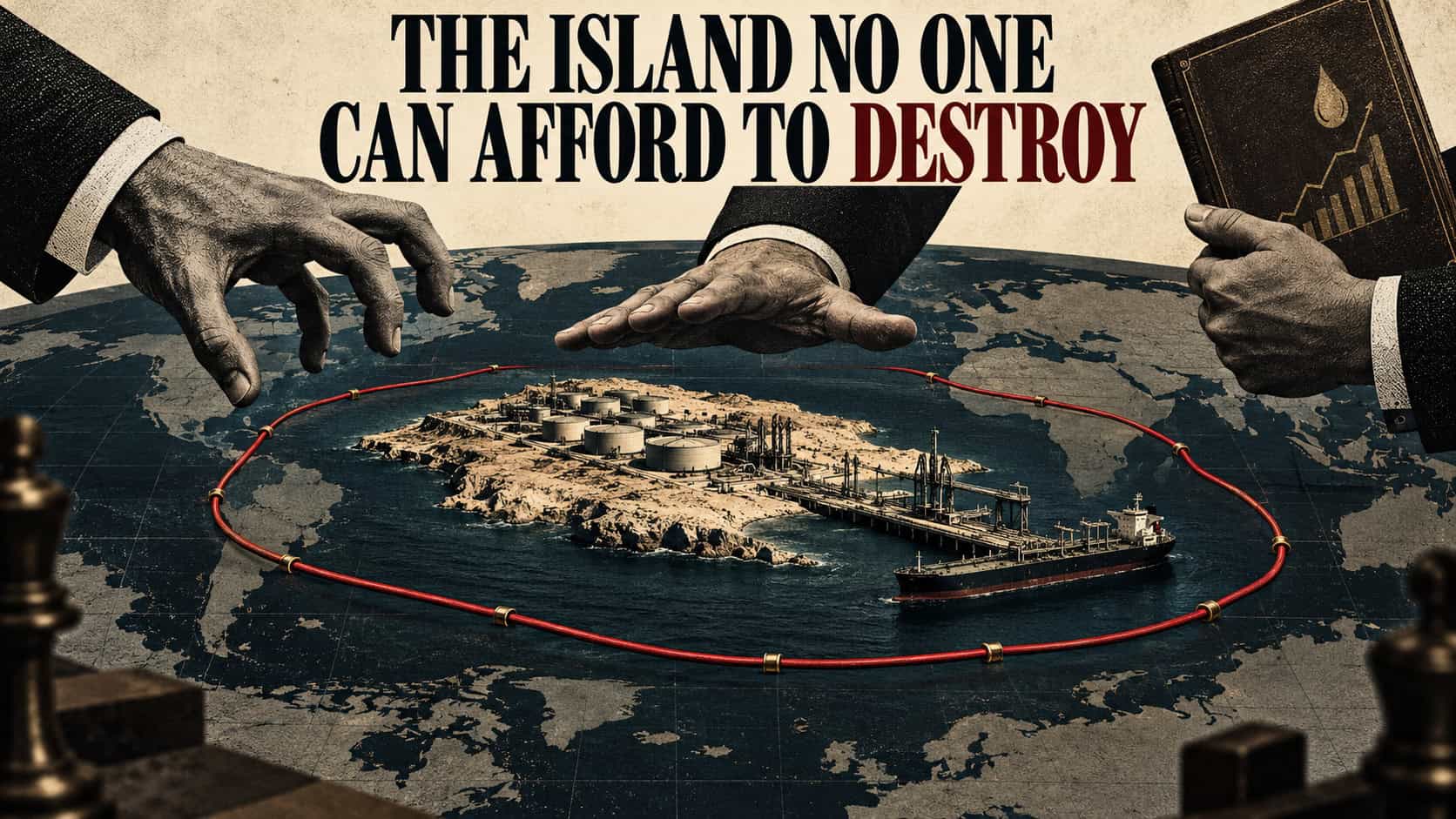
Kharg Island oil terminal encircled on a global chessboard as competing powers reach toward it
There is something almost reassuring about the hypocrisy surrounding Kharg Island. In an international order increasingly deprived of honesty, the little coral outcrop at least provides clarity.
Iran calls its petroleum industry a sovereign birthright while using the resulting revenue to sustain a regime that cannot obtain obedience without coercion. Washington condemns Iranian oil while understanding perfectly well that removing too much of it from circulation could punish American motorists. China denounces Western aggression while purchasing the discounted crude that keeps Tehran solvent. And the world’s energy markets, supposedly governed by numbers and reason, convulse whenever a politician uploads a theatrical video to social media.
Kharg Island is therefore not merely an oil terminal.
It is a hostage whom everyone threatens and no one can afford to kill.
The Myth of the Irreplaceable Island
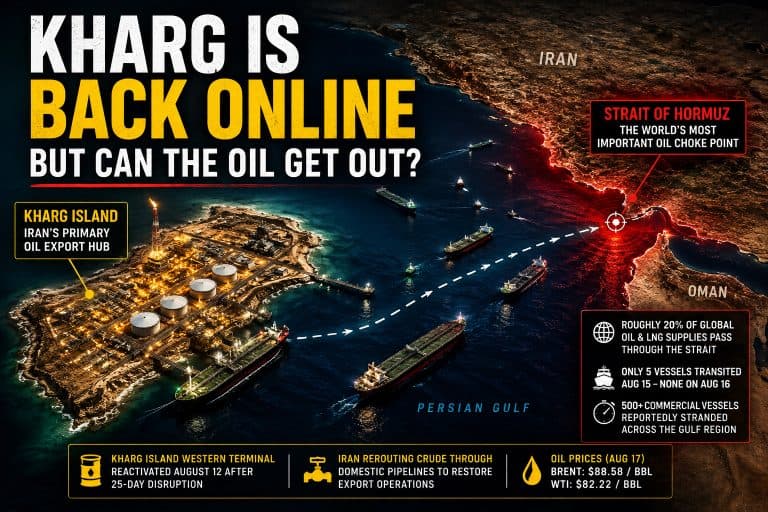
Before the current conflict, approximately 90% of Iran’s crude exports passed through Kharg Island. Its deep-water berths, storage tanks and connections to Iran’s oil fields made it the principal doorway through which Iranian petroleum entered the world.
This has produced the lazy conclusion that destroying Kharg would destroy Iran’s oil economy.
It would certainly wound it. It might cripple exports for a time. It could deprive Tehran of revenue and force Iran to rely upon smaller terminals, clandestine transfers and an increasingly baroque collection of smugglers, shell companies and conveniently incurious intermediaries.
But governments rarely collapse as neatly as their enemies predict.
Sanctioned states do not simply surrender. They become criminally inventive. Tankers change names, flags and owners. Tracking equipment ceases to function at remarkably convenient moments. Cargoes are transferred at sea. Oil changes nationality somewhere between seller and refinery.
The United States Treasury’s latest sanctions illustrate the point. American officials allege that a Turkish financial network helped move Iranian oil revenue from China into Turkey, where it could be converted into cash and gold. The Turkish bank targeted by Washington denies the accusations.
Whatever the ultimate legal outcome, the alleged arrangement reveals an awkward fact: when oil is profitable enough, it develops an almost supernatural ability to acquire new paperwork.
America’s Convenient Restraint
American threats against Kharg Island are frequently presented as evidence of restraint.
The United States possesses the military ability to inflict catastrophic damage on the terminal. Previous strikes targeted military installations while sparing much of the petroleum infrastructure. This distinction has been offered as proof that Washington seeks leverage rather than indiscriminate destruction.
Perhaps it does.
But restraint becomes rather less noble when it also happens to prevent an energy shock.
Destroying Kharg’s export infrastructure would not merely punish the Iranian government. It could remove significant volumes of crude from an already disrupted market, frighten commercial shipping, increase insurance costs and send fuel prices higher in countries whose citizens possess no influence over Tehran’s policies.
Washington must therefore perform an increasingly peculiar ritual: threaten Iran’s most valuable asset convincingly enough to terrify Tehran, but not so convincingly that traders begin pricing its destruction as inevitable.
This is not quite peace. It is extortion conducted within the tolerances of the futures market.
Iran’s Revolution Runs on Oil
The Iranian regime has its own contradiction.
It presents itself as the incorruptible enemy of Western influence, yet its survival depends upon selling petroleum into a global commercial system whose rules it publicly despises. Its revolutionary slogans may be written in Persian, but its invoices remain attached to the price of crude.
Kharg Island exposes this dependency with unusual cruelty.
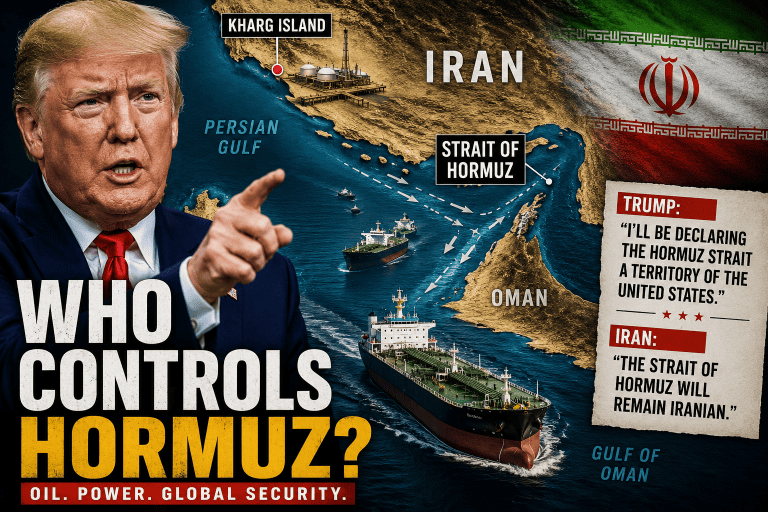
Iran can threaten shipping through the Strait of Hormuz. It can denounce sanctions, defy inspectors and promise retaliation. But it must also persuade buyers, insurers, shipowners and financial intermediaries that doing business with Iran remains possible.
A nation may celebrate resistance. A tanker captain generally prefers a navigable route and a functioning port.
That difference between political theater and commercial reality is where the Iranian government now finds itself trapped. Tehran needs Kharg Island not merely intact, but credible. A terminal that technically survives while ships refuse to approach it is only an expensive monument to stranded oil.
China’s Principles Are Available by the Barrel
Then there is China, whose role is often described in the sterile language of “strategic partnership.”
This phrase is useful because it avoids discussing the transaction underneath it.
China gains access to energy. Iran gains a customer large enough to resist American pressure. Beijing acquires influence over a sanctioned and increasingly dependent supplier, while Tehran gets the foreign currency and commercial oxygen necessary to continue resisting Washington.
One need not mistake this for friendship.
The appetite for discounted petroleum has always been more dependable than diplomatic affection. If Iranian oil becomes too dangerous, too politically costly or simply unnecessary, the warm language of partnership may cool with admirable speed.
Russia has now argued that China, rather than OPEC, is becoming the decisive force in global energy markets. Whether or not one accepts that entire claim, Beijing’s purchasing decisions plainly give it enormous influence over producers desperate for access to the Chinese market.
Kharg Island may belong to Iran, but a considerable portion of its strategic value is determined elsewhere.
The Strait Where Certainty Disappears
Shipping data provides its own lesson in the unreliability of appearances.
Visible vessel traffic through the Strait of Hormuz recently fell dramatically below both its prewar level and the already-depressed recent average. Yet tracking data cannot account perfectly for ships operating with their identification systems disabled.
Thus the modern oil trade enters a wonderfully absurd condition: everyone knows tankers are moving, everyone knows some do not wish to be observed, and analysts must estimate how much supposedly blockaded oil is passing through one of the most heavily watched waterways on Earth.
The blockade exists.
So does the trade.
Both propositions can be true because sanctions and blockades are not impermeable walls. They are systems for increasing cost, danger and inconvenience. Their success is measured not by whether every barrel is stopped, but by how expensive each surviving barrel becomes to sell.
Kharg Island remains important because it concentrates that contest in one place. Pipelines, storage tanks, tanker berths, naval power, sanctions enforcement and global demand all converge upon a few square miles of Iranian territory.
It is less an island than a pressure gauge.
Why Kharg Island Remains Standing
Those expecting a clean conclusion will be disappointed. History seldom provides one, and oil almost never does.
Kharg Island survives because each interested power sees greater value in threatening it than in destroying it.
Iran needs the revenue. China values the supply and leverage. Washington values the threat. Neighboring exporters need the Persian Gulf to remain insurable. Consumers everywhere prefer moral clarity right up until it increases the price displayed above the gasoline pump.
This arrangement is unstable, cynical and dangerous.
It is also rational.
That is perhaps the most uncomfortable fact of all. Kharg Island does not remain standing because the governments surrounding it have discovered wisdom or mercy. It remains standing because their competing interests have temporarily produced the same conclusion.
The island is worth more alive.
For now.