Mad Max Was Never About The Apocalypse. It Was About Oil.
The first mistake people make about Mad Max is to call it a vision of the future. The second is to imagine that it takes place after civilization has disappeared.
Civilization has not disappeared. It has merely lost its public-relations department.
Government survives as tyranny. Religion survives as death worship. Commerce survives as extortion. Diplomacy survives as the temporary exchange of fuel, ammunition and hostages. The ruling class remains comfortably above the dust while young men are encouraged to die theatrically on its behalf.
Even the energy policy remains recognizable.
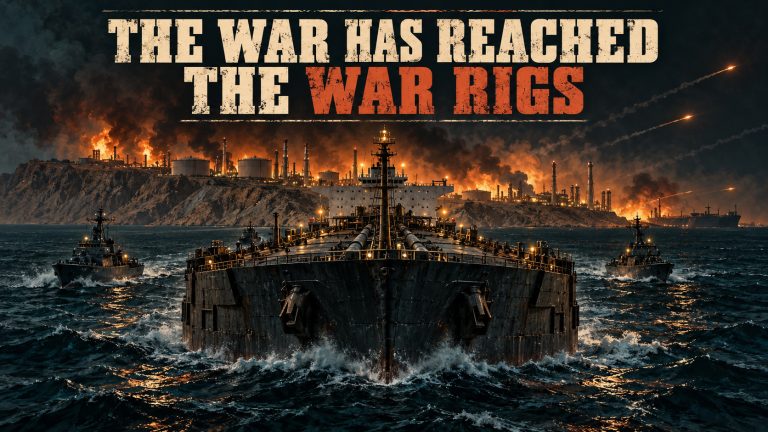
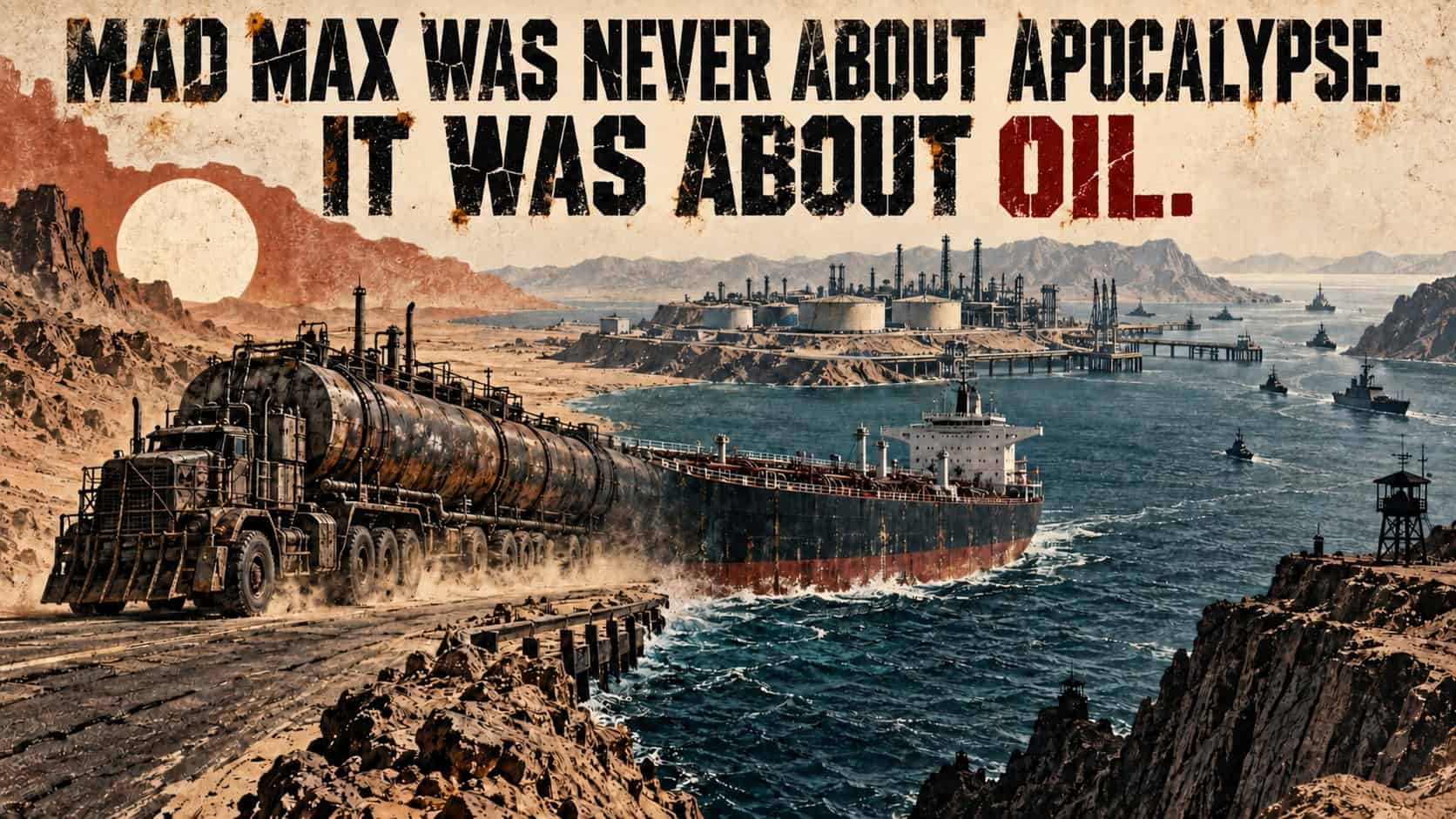
Oil is called guzzoline because nobody has time left for euphemism. A blockade is a siege. A supply chain is a War Rig. Strategic infrastructure is Gas Town. And the phrase “national security” has been replaced by the much more honest sound of an engine refusing to start.
Look toward Kharg Island and the Strait of Hormuz, and one begins to suspect that Mad Max was not prophecy at all.
It was journalism with better costumes.
Welcome to Gas Town
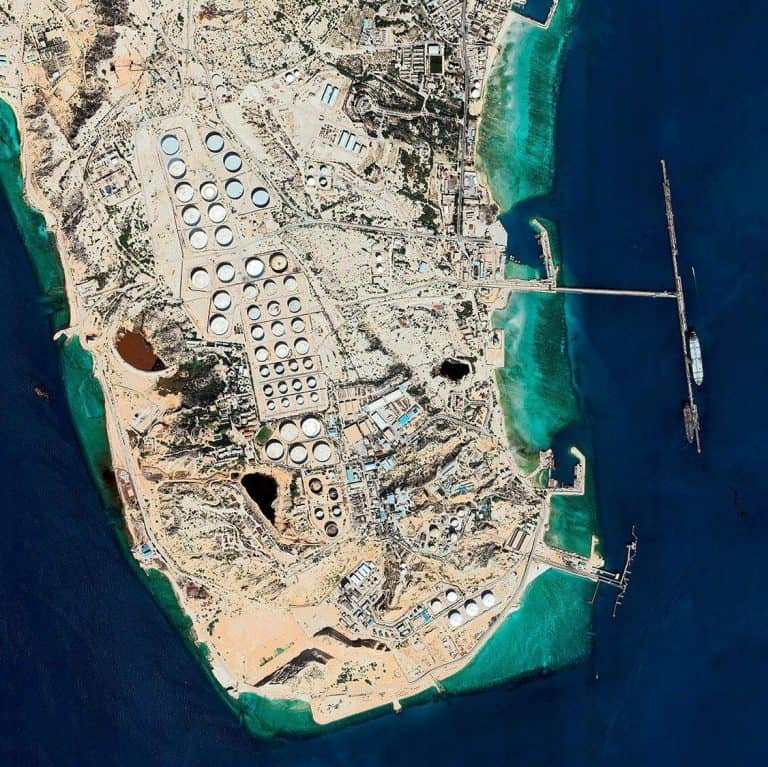
Kharg Island is a small coral outcrop in the Persian Gulf that geography, geology and human appetite have conspired to make enormously important.
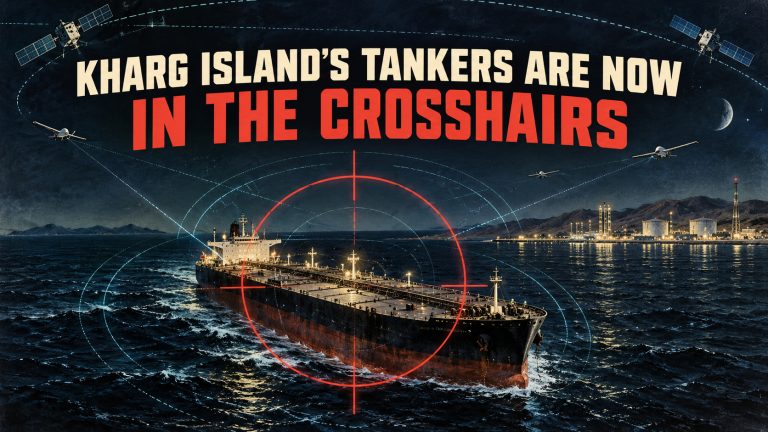
Before the current conflict, approximately 90% of Iran’s crude exports passed through it. Pipelines carry petroleum from Iranian oil fields to the island. Storage tanks hold it. Deep-water berths allow tankers to collect it. From there, the oil begins its journey toward foreign refineries, industrial economies and motorists who prefer not to know too much about where their fuel originates.
Kharg is often described as Iran’s economic lifeline. This is accurate but incomplete. A lifeline suggests something passive, like a tube in a hospital.
Kharg Island is closer to an exposed artery.
Iran requires it to earn revenue. China values the oil that passes through it. Washington values the threat of interrupting it. Traders value its continued operation. Military planners value its vulnerability. Television producers value the possibility of its destruction.
Everyone has found a use for Kharg Island. The inhabitants of Kharg Island may be forgiven for wondering when they will be consulted.
In Mad Max: Fury Road, Gas Town possesses power because it controls fuel. Its importance does not come from culture, virtue or popular consent. It comes from the elementary fact that machines without fuel become scenery.
Kharg Island operates according to the same brutal arithmetic.
The flags are different. The principle is not.
The Civilized War Rig
The War Rig is among the most honest vehicles in cinema.
It does not pretend to be a humanitarian mission. It does not publish statements about regional stability. It carries fuel and supplies through hostile territory while armed factions attempt to seize or destroy it.
The modern oil tanker performs essentially the same task, though its operators possess better lawyers.
To leave the Persian Gulf, tankers must pass through the Strait of Hormuz, a narrow waterway subjected to military patrols, missile threats, drone attacks, mines, blockades, sanctions and the nervous attention of every serious energy trader on Earth.
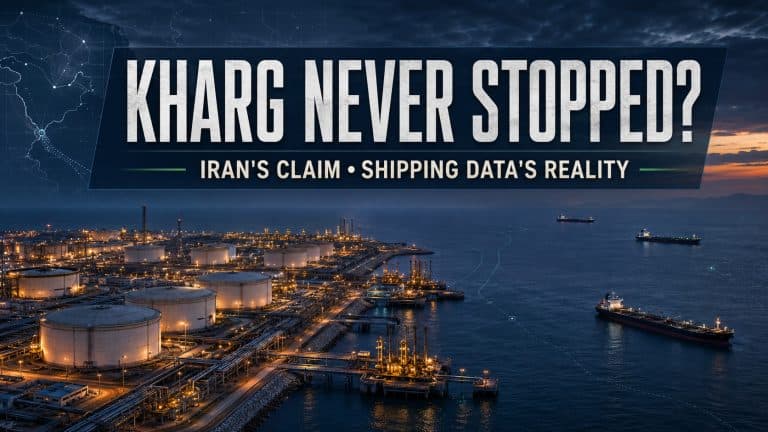
Visible commercial traffic through the strait has fallen sharply from its prewar level. Yet visible traffic is not necessarily total traffic. Some vessels travel with their identification systems disabled, participating in the curious practice known as “dark shipping.”
There is something almost poetic about an oil tanker attempting to become invisible.
It may stretch hundreds of feet, carry an internationally significant cargo and be observed by satellites belonging to several governments. Yet once its transponder goes dark and its ownership disappears behind sufficient paperwork, the modern world agrees to treat its identity as something of a philosophical question.
The War Rig relied upon armor, engines and armed escorts.
The tanker relies upon shell companies, flags of convenience, altered documents and the ancient human capacity not to notice profitable things.
Scarcity Is a Political Achievement
Immortan Joe does not rule merely because he possesses water. He rules because he controls its release.
“Do not become addicted to water,” he tells the desperate people below, moments after making their desperation the foundation of his authority.
This is the sort of statement that would be recognized immediately as monstrous if it were not so similar to the logic of actual governments.
Resources do not have to disappear to become scarce. They need only be trapped behind the correct combination of danger, bureaucracy and force.
Iran can increase the cost of Persian Gulf oil without stopping every tanker. It must merely create enough uncertainty that shipowners hesitate and insurers begin reaching for larger numbers.
The United States can damage Iranian petroleum revenue without intercepting every barrel. It must make the oil sufficiently difficult to transport, finance and sell.
The market then performs its celebrated magic by transferring the consequences to people who had no role in creating the dispute.
A blockade becomes a higher transportation bill. A missile threat becomes an insurance premium. A sanction becomes a discount demanded from a desperate seller. Eventually, all of it arrives at the consumer dressed as inflation, whereupon politicians express astonishment at the price of gasoline.
The shortage may be manufactured.
The bill is quite real.
Witness the Statesman
No examination of Mad Max would be complete without spectacle.
Its rulers understand that power must be performed. Engines roar. Bodies are painted. Religious promises are issued. Young men are offered immortality on the condition that they die before discovering the fraud.
One might dismiss this as cinematic exaggeration if modern political leaders were not so determined to compete with it.
Threats now arrive through social-media posts. Military operations are introduced like entertainment products. Videos are edited for drama before facts have acquired the inconvenience of certainty. Artificially generated images can depict destruction that never occurred while still producing genuine political and economic consequences.
A recent video showing Kharg Island consumed by enormous explosions was determined to be AI-generated. No corresponding attack on the island was confirmed during that episode.
Yet dismissing it as “fake” misses the purpose.
The video was not intended to describe reality. It was intended to threaten one.
Its message was simple: We can imagine your destruction vividly, publicly and on demand.
This was political theater performed for Tehran, domestic supporters and the oil market simultaneously. Each audience was meant to see something different. Iran saw a warning. Supporters saw strength. Traders saw risk.
Immortan Joe required drums, engines and a guitarist suspended from elastic cords.
The modern statesman requires a smartphone and a sufficiently impressionable audience.
Progress is a marvelous thing.
The War Boys and Their Masters
The most grotesque inhabitants of the Mad Max world are not the War Boys. They are the people who taught the War Boys to welcome death.
The boys are sick, manipulated and promised eternal recognition. Their rulers remain safely positioned to survive the sacrifice they demand from others.
Here, unfortunately, the comparison ceases to be amusing.
Governments have always possessed a magnificent vocabulary for converting the ambitions of leaders into the obligations of young people. They speak of destiny, honor, resistance, duty, national survival and historical necessity. The words vary according to the flag. The bodies remain depressingly interchangeable.
Iran presents sacrifice as resistance to imperial aggression. The United States describes force as the defense of order and navigation. Every combatant insists that its violence is reluctant and its adversary’s violence reveals an essential barbarism.
Meanwhile, soldiers, sailors, oil workers and civilians inhabit the locations selected for retaliation.
The people who speak most movingly about sacrifice display a remarkable talent for arranging the sacrifice of somebody else.
The War Boys are at least spared the committee hearing.
China, the Benevolent Customer
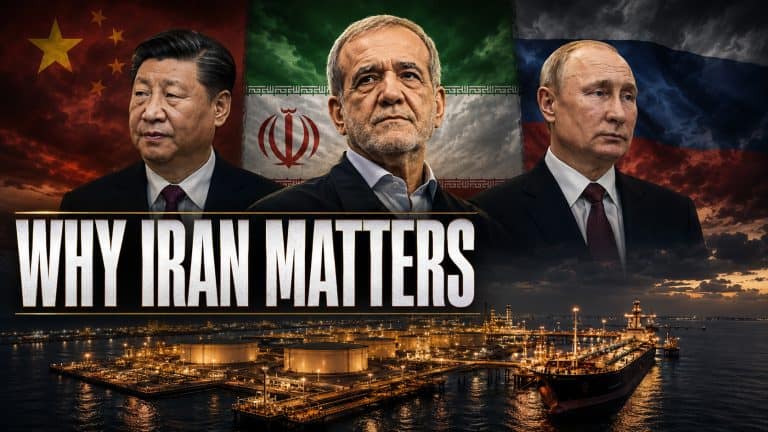
China is sometimes described as Iran’s ally. This is one of those flattering diplomatic terms that becomes less impressive once translated into money.
Iran has oil it needs to sell. China has an appetite for energy and sufficient economic weight to resist American pressure. Iran receives revenue. China receives supply, influence and negotiating leverage over a seller with limited alternatives.
This may be strategically important. It should not be mistaken for affection.
Nations do not have friends when petroleum is involved. They have customers, suppliers and temporary areas of mutual convenience.
China will purchase Iranian oil while the price, risk and diplomatic cost remain acceptable. Should that calculation change, no quantity of revolutionary poetry will cause a refinery to accept an unwanted shipment.
Even the alliances of the wasteland are founded on necessity. Gas Town requires water. The Citadel requires ammunition. The Bullet Farm requires fuel. They cooperate because ideology cannot power an engine or irrigate a crop.
The supposedly advanced world conducts the same transactions with more elaborate banquets.
No, the Middle East Is Not the Wasteland
At this point, one qualification is necessary—not as an apology, but as a defense against stupidity.
The Middle East does not resemble Mad Max because its people are uniquely violent, irrational or trapped in antiquity. This familiar caricature has survived far too long among people whose own countries have spent centuries invading, bombing, arming and reorganizing the region.
Tehran is a modern city. Iran is a complex society. The Persian Gulf is crossed by some of the most technologically advanced commercial and military systems ever constructed.
The wasteland comparison concerns the structure of power, not the worth of a civilization.
Kharg resembles Gas Town because the global economy has concentrated extraordinary power in a vulnerable industrial location. The Strait of Hormuz resembles the wasteland road because the movement of fuel through a narrow corridor determines what distant societies can afford to manufacture, transport and consume.
The demand is not exclusively Iranian, Arab, Chinese or American.
It belongs to all of us.
The oil leaves Kharg because someone elsewhere has purchased it. The tanker enters dangerous water because a refinery is waiting. The governments compete for influence because their citizens expect fuel to remain abundant, affordable and politically invisible.
If the Persian Gulf has become a stage for resource conflict, much of the world bought a ticket and commissioned the scenery.
The Wasteland Begins at Home
Western audiences watch Mad Max with the pleasant conviction that the wasteland belongs to someone else.
Its people are desperate. We are consumers. Its rulers hoard resources. We maintain strategic reserves. Its factions attack supply convoys. We enforce blockades. Its leaders use mythology to conceal exploitation. Ours employ communications directors.
Then traffic through Hormuz declines.
Oil prices rise. Airlines calculate fuel costs. Markets tremble. Politicians suddenly discover geography. The ordinary motorist watches the numbers climb above the gasoline pump and learns that a small island thousands of miles away has somehow acquired an interest in his household budget.
The distance between civilization and the wasteland turns out to be approximately one interrupted delivery.
This is the unpleasant truth concealed by the machinery of modern life. We have not transcended the struggle for resources. We have made it sufficiently efficient that most of us can ignore it.
Pipelines hide the journey. Tankers disappear over the horizon. Financial institutions disguise coercion as compliance. Political language turns threats into policy and suffering into statistics.
Kharg Island is disturbing because it makes the arrangement visible.
There stands the oil terminal. There wait the tankers. There patrol the warships. There gather the governments, each proclaiming a noble purpose while keeping one eye fixed upon the price of crude.
Mad Max did not predict a future in which civilization would become obsessed with fuel.
It removed the manners from the civilization we already possess.
Kharg Island does not resemble Gas Town because the Middle East has descended into fantasy. It resembles Gas Town because both reveal the same elementary truth: whoever controls movement controls power, and whoever controls fuel influences movement.
The costumes differ. The speeches are longer. The vehicles are generally better maintained.
But when the tankers stop moving, we all enter the wasteland together.