The War Moved West: The Persian Gulf Is Becoming a Battlefield Without Borders
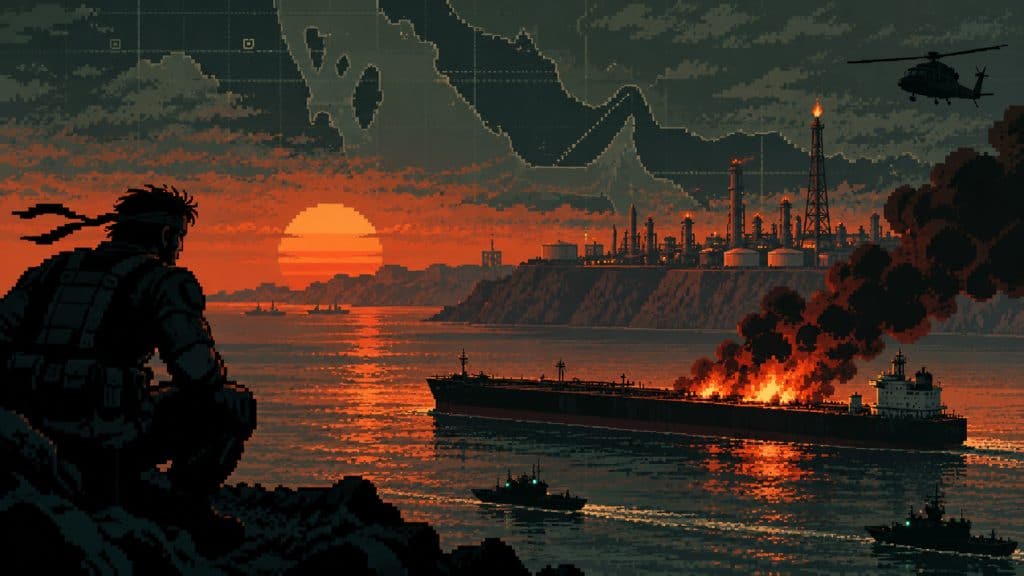
An oil tanker burns off Qatar, Washington rehearses another war, and the world’s most important energy corridor becomes a monument to political stupidity.
There is something almost admirable about the ability of governments to declare a situation under control while the evidence to the contrary is quite literally on fire.
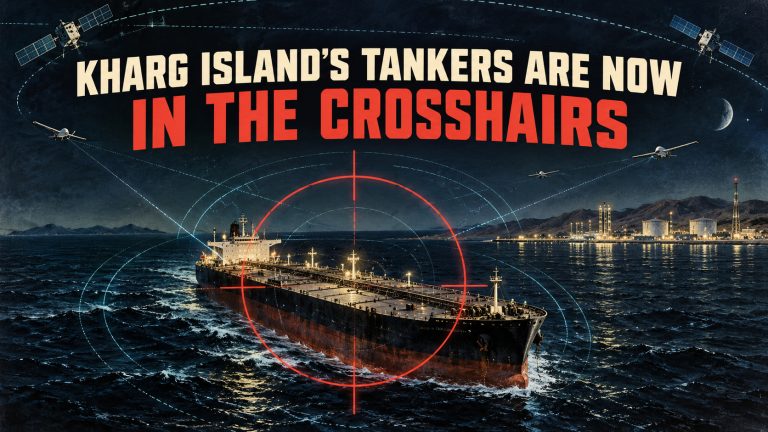
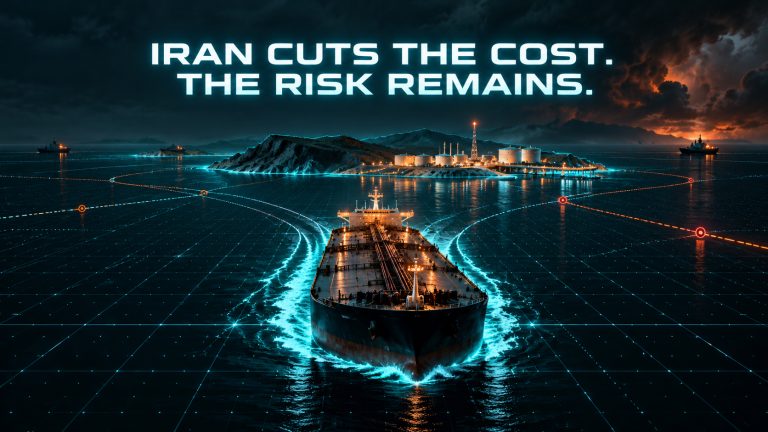
On Wednesday, October 7, an oil tanker was struck by multiple projectiles approximately 51 nautical miles north of Qatar. Casualties were reported. The vessel, identified by maritime intelligence sources as the Acers, was reportedly able to extinguish the resulting fire and continue toward Kuwait.
The identity of the attacker has not been independently established. That distinction matters, particularly in a region where accusation frequently arrives long before evidence and where inconvenient facts are often treated as an administrative nuisance.
But the geography is beyond dispute.
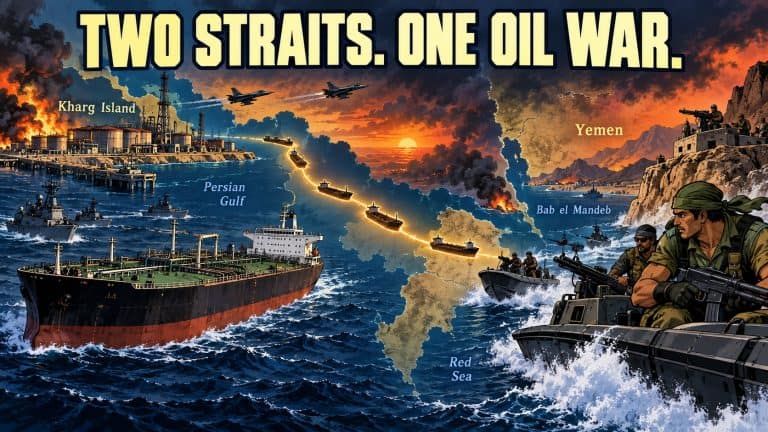
This was not another incident in the narrow and notoriously dangerous Strait of Hormuz. It occurred deep inside the Persian Gulf, far to the west of the maritime corridor that Washington has spent considerable military and diplomatic capital attempting to secure.
The war has acquired a larger map.
And the people responsible for managing it seem determined to discover just how much of that map they can set alight.
The Illusion of American Control
For months, Washington has presented its maritime strategy as a demonstration of overwhelming American power. Shipping corridors would be protected. Iranian interference would be punished. Oil would continue moving, and the international economy would be spared the consequences of another Middle Eastern catastrophe.
There was, as usual, one small difficulty.
The enemy was not obliged to cooperate with the plan.
The American-supported southern corridor through Hormuz was supposed to provide commercial shipping with a measure of security. Yet the attack near Qatar illustrates the fundamental weakness of defending a passage while leaving the waters beyond it vulnerable.
A tanker can survive the strait only to encounter danger hundreds of miles farther along its journey.
It is rather like hiring an armed guard to escort you through a dangerous neighborhood, then having him wave goodbye halfway down the street.
The United States Central Command insists that American forces and regional partners control the strait. Iranian officials make competing claims of control and disruption.
Both sides are engaged in the familiar military pastime of announcing victory over a situation that stubbornly refuses to behave like one.
The more useful question is not who controls Hormuz in a press release.
It is whether a merchant captain can sail from the Gulf to the open ocean without becoming an unwilling participant in somebody else’s foreign policy.
The answer is becoming increasingly uncomfortable.
Washington Prepares the Next Chapter
While the tanker was being attacked, reports emerged that the Pentagon had instructed U.S. Central Command to complete preparations for renewed major combat operations against Iran.
According to Axios, potential targets include Iranian energy infrastructure, nuclear facilities, and other strategically important sites.
The report did not establish that a final order to attack had been given.
And on Thursday, President Donald Trump publicly promised that the United States would not attack Iran before the November 3 midterm elections, while maintaining the blockade and describing negotiations as productive.
It is a remarkable state of affairs when the timing of another possible bombing campaign must be discussed alongside the American electoral calendar.
One might reasonably hope that the decision to unleash military force would depend on necessity, legality, achievable objectives, and the probable consequences for millions of human beings.
Instead, the public is invited to contemplate the significance of November 3.
War has always had a political dimension. What is new is the almost cheerful absence of embarrassment about it.
Trump’s own statements have hardly offered a model of consistency. On Wednesday, he suggested that an agreement with Iran was not something he particularly wanted. By Thursday, he was emphasizing productive discussions and promising a pause in attacks until after the election.
Perhaps diplomacy is advancing. Perhaps military preparations are intended to strengthen the American negotiating position. Perhaps both are true.
But a government that treats negotiation as an optional inconvenience should not be surprised when its adversaries begin treating military escalation as their principal bargaining instrument.
Tehran’s Strategy of Making Everyone Miserable
None of this absolves the Iranian leadership.
The Islamic Republic has spent decades perfecting a particularly destructive form of political survival: making the consequences of confronting it so expensive that its enemies hesitate to finish the confrontation.
It is not necessary for Tehran to defeat the United States Navy.
It need only persuade shipping companies, insurers, oil traders, and foreign governments that the price of operating in the Gulf has become intolerable.
A drone is considerably cheaper than an oil tanker.
A missile is cheaper than a port.
And the uncertainty created by either can be worth considerably more than the physical damage inflicted.
This is the ugly arithmetic of asymmetric warfare.
Iran’s own petroleum export system has already suffered catastrophic disruption. According to the intelligence brief compiled for this publication, Kharg Island has recorded no September loadings, with its last identified loading dating to August 25.
An economy deprived of its principal source of export revenue has fewer commercial assets left to protect.
That does not make escalation rational in any humane sense. It makes escalation easier for a leadership willing to distribute the suffering of its own population while threatening the prosperity of its neighbors.
The people of Iran deserve better than a government that treats national impoverishment as evidence of revolutionary endurance.
And the people of the Gulf deserve better than being turned into collateral in a dispute they did not create.
Kharg Island: The Silence at the Center of the Storm
There is an extraordinary irony in the present crisis.
Kharg Island, once the indispensable beating heart of Iran’s oil export economy, is now largely absent from the movement of crude that continues to shape the conflict.
Its loading facilities, pipelines, storage tanks, and offshore infrastructure were built to move enormous quantities of Iranian petroleum into international markets.
Now, according to the latest shipping intelligence available to this publication, its export activity remains stalled.
Yet Kharg has not become irrelevant.
Quite the opposite.
Its inactivity helps explain the changing character of the war.
When a country’s most valuable export terminal is no longer functioning as a commercial asset, the strategic contest shifts toward the ability to disrupt everybody else’s commerce.
This does not prove that Tehran ordered the attack off Qatar. Attribution remains unresolved, and speculation should not be passed off as intelligence.
But it does reveal the dangerous logic of the wider confrontation.
Iran cannot easily restore its own oil trade. Its adversaries cannot guarantee the safety of everyone else’s.
The result is an increasingly destructive competition in which the ability to deny prosperity may count for more than the ability to produce it.
Kharg Island remains central to the story precisely because its silence is so consequential.
The Oil Market Has a Better Memory Than Politicians
On Wednesday, Brent crude settled at approximately $100.20 per barrel.
By Thursday, prices had surged above $104 as traders absorbed the tanker attack, reports of American military preparations, and additional supply disruptions associated with Hurricane Isaias in the Gulf of Mexico.
The International Energy Agency is accelerating the release of previously agreed emergency petroleum stocks, with particular attention to diesel.
This is supposed to reassure the market.
And perhaps it will, temporarily.
But oil reserves cannot repair the political decisions that made their release necessary.
They cannot guarantee the safety of tankers. They cannot settle the question of who controls the Strait of Hormuz. They cannot prevent a missile from striking a refinery or persuade an insurance company to ignore the possibility.
The petroleum market possesses one virtue conspicuously absent from many governments: it is not obliged to believe official optimism.
It responds to risk.
And the risk is spreading.
The ports of Qatar, Kuwait, Bahrain, Iraq, and Saudi Arabia are not isolated pieces on a military chessboard. They are connected to the industries, transportation networks, electrical grids, and consumer economies of much of the planet.
The consequences of disruption do not remain politely within national borders.
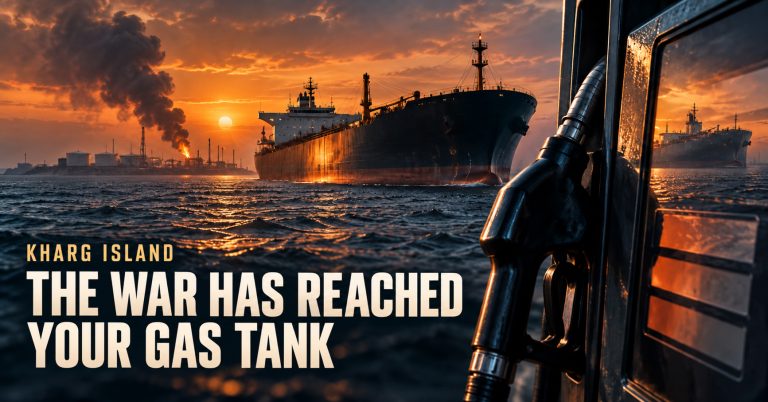
They arrive in the price of fuel, the cost of shipping, the expense of food, and the household budgets of people who have never heard of Kharg Island.
It is an expensive education in geography.
The Diplomats Are Still Talking. For Now.
Iranian Foreign Minister Abbas Araghchi has indicated that Tehran will respond to American proposals within days.
Messages continue moving through regional intermediaries, including Qatar.
That is encouraging, though hardly sufficient grounds for celebration.
Diplomacy is not a magical incantation. It requires that the parties involved possess both something to offer and some willingness to accept an outcome less satisfying than total victory.
Washington wants to prevent Iran from threatening regional security while preserving American credibility.
Tehran wants relief from economic strangulation without appearing to surrender.
Israel has its own security calculations.
The Gulf monarchies want their infrastructure intact, their ports operating, and their economies spared another round of military experimentation.
These interests are not identical, and pretending otherwise will not make them so.
Yet they share one obvious fact: a wider regional war would be ruinously expensive, and no government involved has demonstrated a convincing ability to control its consequences.
That should be sufficient reason to pursue an agreement.
Unfortunately, governments are frequently more concerned with appearing strong than with exercising the discipline that genuine strength requires.
A Battlefield Without Borders
The attack near Qatar should be understood as something more than another entry in the growing catalogue of maritime violence.
It is a warning about the geographical expansion of a conflict whose participants already struggle to control its political consequences.
The Strait of Hormuz was once the principal focus of international anxiety.
Now the concern extends westward into the Persian Gulf itself.
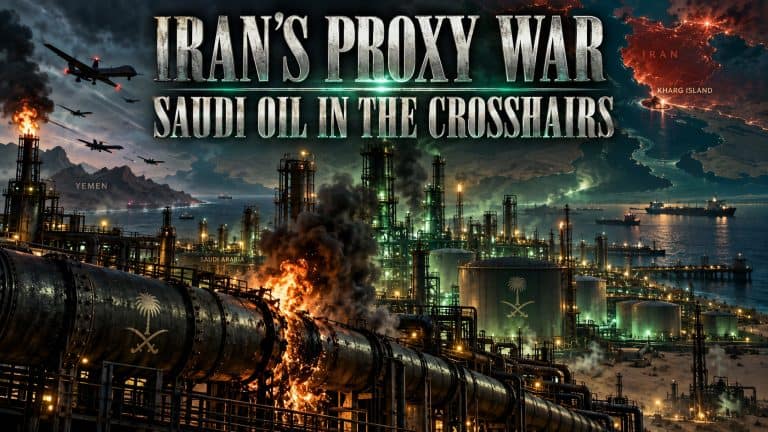
A vessel that successfully navigates Hormuz may still be vulnerable near Qatar. A refinery in Saudi Arabia may be affected by developments in Yemen. A military decision in Washington may alter insurance premiums in London and fuel prices in Nebraska.
And Kharg Island, motionless at the center of Iran’s crippled export system, remains a reminder that destroying an opponent’s economic capacity does not necessarily destroy his ability to cause economic damage.
That is the great strategic absurdity of this war.
Every side insists that its actions will establish security.
Every escalation makes security more elusive.
Every new threat is presented as a necessary response to the previous threat.
And every government seems to believe that the next application of force will somehow produce the stability that the last one failed to deliver.
The tanker off Qatar is the latest evidence that the battlefield is expanding faster than the political imagination of those directing it.
The question is no longer whether the war can spread beyond the Strait of Hormuz.
It already has.
The question is whether anyone with the authority to stop it possesses the wisdom to recognize what that means.
And wisdom, unlike crude oil, appears to be in dangerously short supply.
KhargIsland.net | October 9, 2026
Sources: UK Maritime Trade Operations Warning 158-26 (October 7); Reuters maritime and shipping coverage (October 8); Axios reporting on Pentagon preparations (October 7) and Trump’s subsequent statement (October 8); oil-market reporting from The Wall Street Journal (October 8); Kharg Island Intelligence Brief (October 8).
Editor’s note: Responsibility for the tanker attack off Qatar has not been independently established. Reported military preparations do not constitute a decision to launch strikes. Shipping and oil-market conditions remain subject to change.