Kharg Island Is the Mako Reactor
If You Played Final Fantasy VII in 1997, You Already Understand the Fight Over Iran’s Oil
There was a moment in 1997 when millions of us stared at a gray PlayStation screen and realized video games had changed.
A train screamed through the darkness.
A flower girl appeared beneath the green glow of Midgar.
The camera climbed higher and higher until the entire city came into view.
Then the music hit.
Bombing Mission.
A few minutes later, Cloud Strife jumped from a train and we were running toward Mako Reactor No. 1.
For a generation of gamers, that reactor was our introduction to Final Fantasy VII.
Almost thirty years later, if you want to understand why a relatively small island in the Persian Gulf matters to the world economy, dust off that old mental map of Midgar.
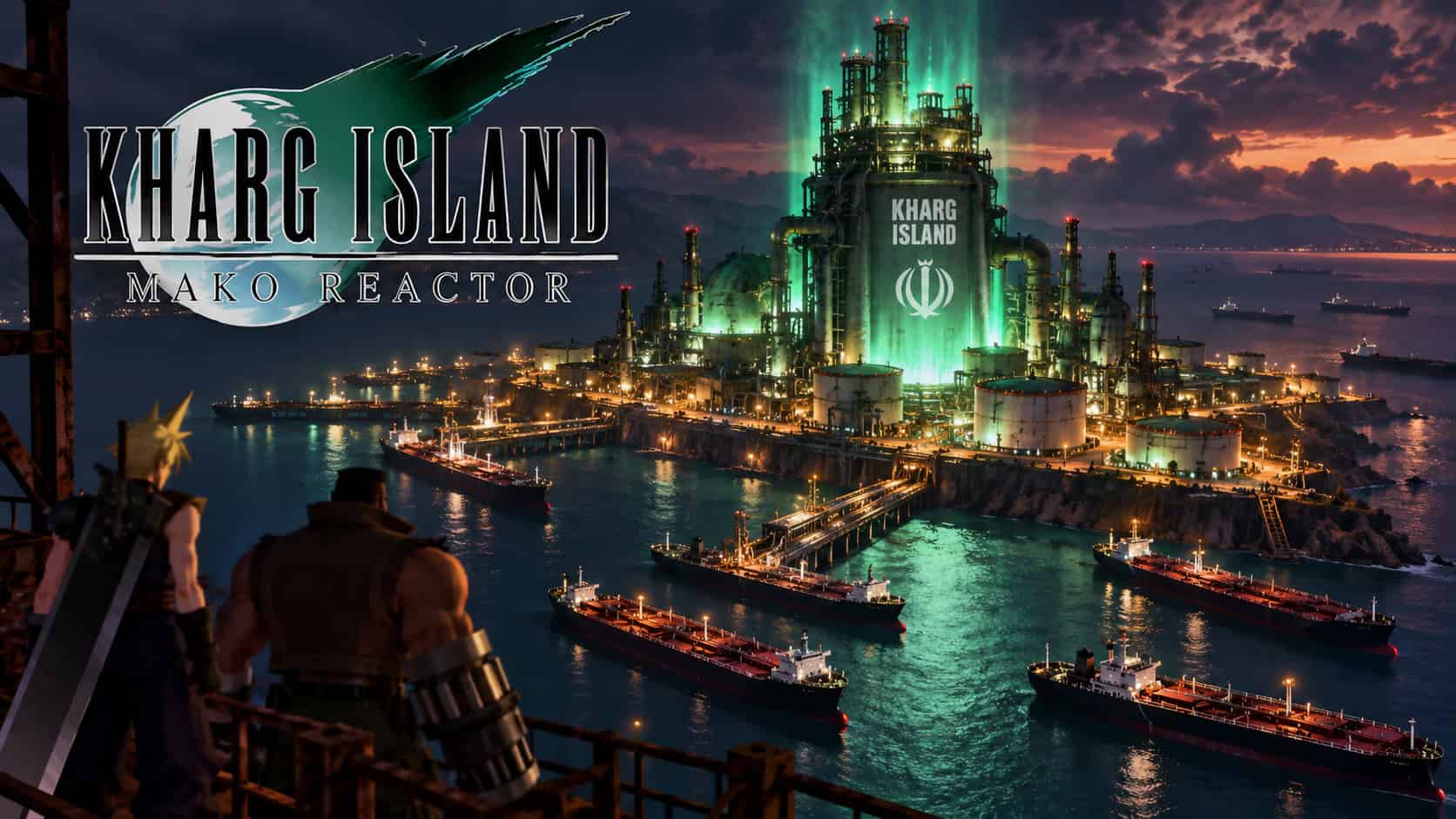
Because Kharg Island is beginning to look a hell of a lot like a Mako Reactor.
And somebody has pulled the plug. This is Kharg Island and Final Fantasy 7:
Welcome to Midgar
In Final Fantasy VII, Midgar is an industrial marvel built around energy.
Everything depends upon Mako.
The lights.
The trains.
The factories.
The military.
The economy.
Shinra doesn’t merely sell energy.
Energy is the foundation of its power.
Replace Mako with petroleum and the metaphor becomes uncomfortable rather quickly.
The modern world doesn’t have glowing green reactors sucking energy from the Lifestream, but it does have enormous terminals, pipelines, refineries, tankers and shipping lanes moving millions of barrels of stored ancient energy around the planet every day.
And Iran has Kharg Island.
For decades, Kharg has been one of the central machines of the Iranian economy.
Iran pumps oil.
Pipelines carry it toward the Persian Gulf.
Kharg loads it onto tankers.
Tankers carry it to customers.
Customers send money back.
The machine continues running.
Except right now, it isn’t.
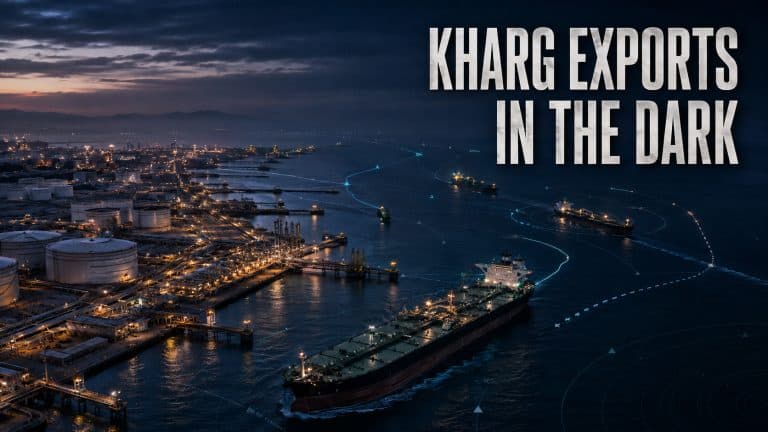
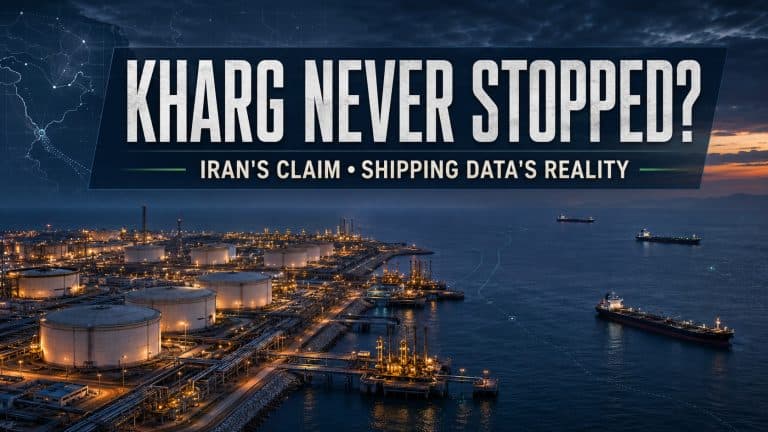
Kharg remains blocked.
There has still been no new Kharg loading.
Around 50 laden Iranian tankers are sitting idle, including 11 east of Kharg.
The barrels exist.
The infrastructure exists.
The customers exist.
But the reactor isn’t producing gil.
Somebody Blew Up Reactor No. 1
This is where the Final Fantasy VII comparison gets interesting.
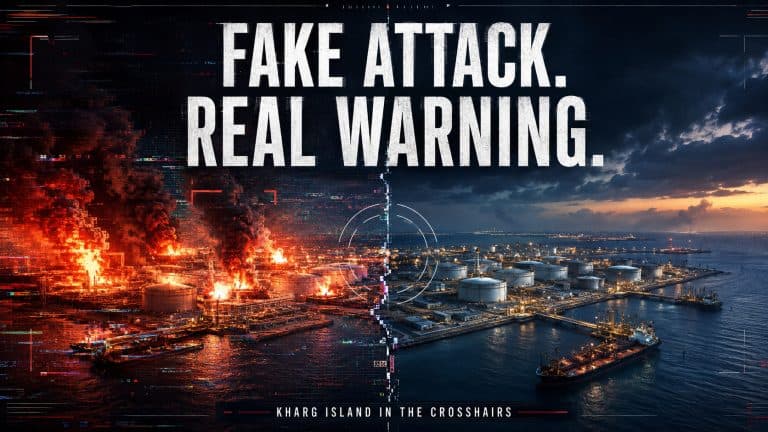
Nobody literally blew up Kharg Island.
In fact, that is precisely the point.
Kharg is still there.
Its tanks remain.
Its loading infrastructure remains.
Yet its economic function has been severely disrupted.
That’s almost more interesting than destroying it.
In Final Fantasy VII, Avalanche attacks Mako Reactor No. 1 because destroying the reactor interrupts Shinra’s ability to convert the planet’s energy into power.
In the Persian Gulf, the United States and its allies are attempting something conceptually similar through blockade and financial pressure.
Don’t destroy the petroleum.
Prevent Iran from converting petroleum into usable economic power.
Washington has now tightened that strategy further.
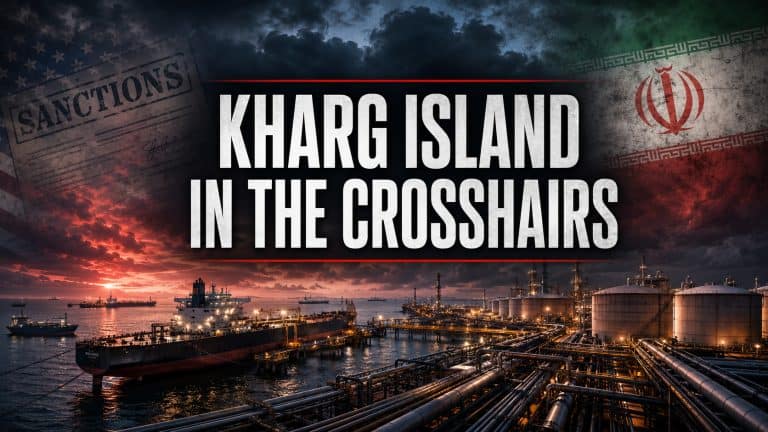
The U.S. Treasury warned foreign banks that institutions continuing relationships with sanctioned Iranian banks could themselves be targeted.
Treasury Secretary Scott Bessent supplied the statistic that explains the strategy better than a thousand pages of sanctions regulations:
Iran loaded zero crude oil onto tankers last month.
Zero.
That is the equivalent of walking into the Sector 1 reactor and discovering the giant green machinery still humming while the energy meter reads nothing.
Barret Wallace Would Understand Tehran
This is where we need to be careful.
Real countries are not video-game characters.
But political personalities occasionally produce some magnificent echoes.
And Iran currently has more than a little Barret Wallace energy.
Barret is furious.
He is revolutionary.
He believes the existing system is fundamentally rigged against him.
He doesn’t trust the people running it.
And when diplomacy fails, Barret’s preferred negotiating instrument is attached to his right arm.
Tehran’s rhetoric increasingly operates on similar emotional terrain.
Iran argues that the existing international order is constructed to constrain it.
Sanctions are illegitimate.
American military power is coercion.
The blockade is economic warfare.
And if Iran cannot freely use the system, Tehran has demonstrated a willingness to make the system considerably less pleasant for everyone else.
The problem is that Barret eventually learns something during Final Fantasy VII.
Blowing up reactors has consequences.
People who had absolutely nothing to do with Shinra get caught underneath the falling debris.
That lesson feels especially relevant this week.
The tanker campaign around Hormuz has accelerated dramatically.
Multiple new maritime incidents have been reported.
The tanker On Peace was struck Tuesday, injuring 12 crew members, 11 of them Indian.
Those sailors aren’t Shinra executives.
They aren’t presidents.
They aren’t generals.
They’re people working aboard a ship.
The NPCs are taking damage now.
And anyone who remembers Sector 7 knows exactly why that should make you nervous.
Trump Has Entered the Shinra Building
Then there is Donald Trump.
Trying to assign Trump a single Final Fantasy VII character is impossible because he has somehow managed to occupy several dialogue boxes simultaneously.
There is some President Shinra in the enormous confidence of American economic and military power.
There is some Rufus Shinra in the belief that fear itself can be an instrument of policy.
And there is occasionally a little Don Corneo in the rhetorical presentation, though perhaps we should leave that particular side quest alone.
Trump says the war is “essentially almost over.”
Asked whether direct negotiations with Iran remain possible, his answer was simple:
“Yeah, always.”
Meanwhile, Washington is tightening the financial blockade rather than answering the latest tanker attacks with publicly announced military strikes.
That distinction matters.
The American strategy presently looks less like sending Cloud into the reactor and more like shutting off Shinra’s bank account.
CENTCOM says 130 ships have now been redirected.
Treasury is threatening foreign banks.
Iranian crude isn’t loading.
The reactor hasn’t exploded.
Someone has simply disconnected it from the grid.
Saudi Arabia Found Another Reactor
Here’s where Tehran has a much bigger problem.
In Final Fantasy VII, destroying one reactor matters because Midgar depends upon the reactor network.
But imagine blowing up Reactor No. 1 only to discover that Shinra had quietly built another energy system outside the city.
That’s Saudi Arabia.
While Hormuz burns, Saudi Arabia is moving roughly 5.8 million barrels per day through its East-West pipeline.
That pipeline carries petroleum across the kingdom toward the Red Sea, bypassing the Strait of Hormuz.
And the market has noticed.
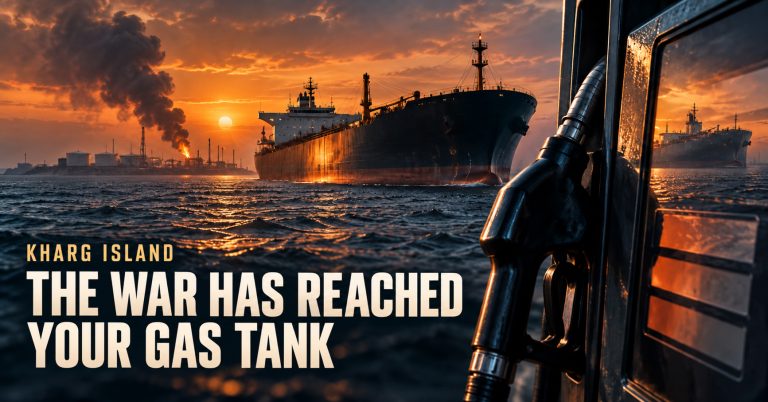
Despite the accelerating tanker attacks, Brent crude fell below $100 Tuesday morning.
That should be deeply disturbing to Tehran.
Iran is escalating the tanker war.
Ships are being hit.
Crews are being injured.
Hormuz remains dangerous.
And the price of oil is going down.
The global economy is beginning to route around the broken reactor.
Cloud Strife Doesn’t Know Whose Side He’s On
Cloud spends much of Final Fantasy VII discovering that the world is considerably more complicated than the mission briefing.
That may be the best analogy for everyone attempting to navigate this crisis.
Washington wants Iran economically isolated without allowing the wider Gulf energy system to collapse.
Iran wants to demonstrate control over Hormuz without permanently destroying the market through which its own petroleum must eventually travel.
Saudi Arabia wants to keep oil flowing while becoming a more attractive supplier to Asian customers.
Iraq wants its crude through the Strait and is now chartering its own tankers to make that happen.
China wants energy.
Europe wants stability.
Shipping companies would very much like their vessels to stop exploding.
Everybody has a mission.
Nobody controls the entire map.
Rufus Shinra Has a Spreadsheet
There is another wonderfully Final Fantasy VII element to all this.
Economics is beginning to matter more than explosions.
Iran can attack ships.
But Saudi Arabia can move 5.8 million barrels per day through another route.
The G7 can release 100 million barrels from strategic reserves.
Iraq can arrange tanker shuttles.
Asian refiners can purchase different crude.
Banks can refuse Iranian transactions.
Insurance companies can reprice risk.
The world doesn’t have to defeat Iran militarily to weaken its leverage.
It merely has to make Iranian oil optional.
That is a much colder weapon.
Rufus Shinra would appreciate it.
And Then There’s Sephiroth
Every Final Fantasy VII veteran knows there comes a point when you realize Shinra isn’t actually the biggest problem in the game.
Remember that feeling?
You’ve spent hours fighting guards, robots and Turks.
President Shinra is the villain.
The corporation is the enemy.
Midgar is the world.
Then you reach the Shinra Building.
Something has gone terribly wrong.
You follow that trail.
You find President Shinra.
And suddenly the game you thought you were playing isn’t the game you’re playing anymore.
Sephiroth has entered the story.
That’s the danger hanging over the Persian Gulf now.
Everyone is concentrating on the current conflict.
Iran.
America.
Hormuz.
Tankers.
Sanctions.
Saudi Arabia.
The blockade.
But behind all of it is the Sephiroth scenario:
A regional war that becomes larger than any of the governments attempting to manipulate it.
Iranian commanders are already threatening “new fronts.”
Saudi Arabia, Turkey and Pakistan have activated their Mecca defense pact.
The United States maintains enormous military power in the region.
Israel continues preparing for the possibility of additional military action.
The Houthis are striking toward Saudi Arabia.
The tanker war is accelerating.
Everybody thinks they’re still playing the Midgar chapter.
The danger is discovering that we’ve already left Midgar.
Kharg Island Is Still Offline
And so we return to the reactor.
Kharg.
No new loading.
Fifty laden Iranian tankers idle.
Iranian oil floating at sea continues to diminish.
The United States says Iran loaded zero crude last month.
Saudi Arabia’s bypass is moving millions of barrels every day.
Brent has fallen below $100.
That’s the scoreboard.
Not speeches.
Not threats.
Not parliamentary declarations.
Not carefully worded diplomatic statements from Qatar.
Watch the reactor.
Because Kharg Island is where Iranian geology becomes Iranian money.
Until tankers begin loading there again, the reactor remains disconnected.
And every day it remains disconnected, the rest of the world becomes slightly better at living without it.
For anyone who played Final Fantasy VII back when memory cards were precious, strategy guides were dog-eared and hearing One-Winged Angel for the first time permanently rearranged something in your brain, the lesson should feel familiar.
You can build an empire around an energy source.
You can build armies to protect it.
You can construct an entire political system around controlling it.
You can convince yourself that because everyone needs your reactor, everyone needs you.
Then one day somebody cuts the power.
And you discover the world has already started looking for another reactor.
Kharg Island hasn’t exploded.
For Tehran, the more frightening possibility may be that it doesn’t have to.