The War Has Finally Reached the War Rigs
Oil tankers once carried the fuel that financed war. Near Kharg Island, they have become part of the battlefield.
Yesterday, the oil tanker could still be mistaken for a commercial vessel. Today, after the arrival of the missile, it has been promoted to its honest rank: a warship without guns, carrying the cargo for which the gunships were sent.
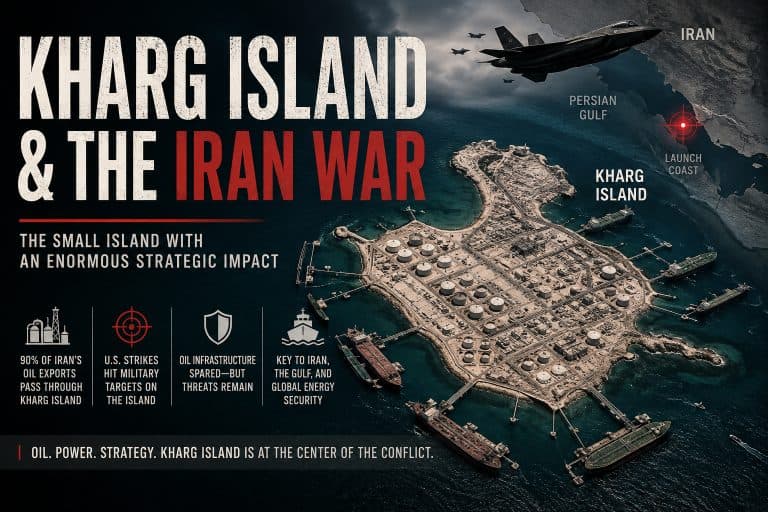
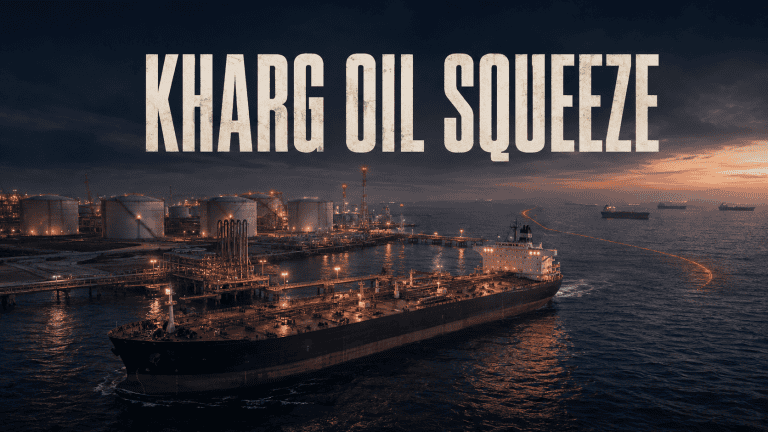
On September 5, U.S. Central Command announced that American forces had struck three Iranian oil tankers. One was reportedly hit near Kharg Island, the small Persian Gulf outpost through which Iran exported roughly 90 percent of its crude before the current war.
The strikes followed what CENTCOM described as ballistic-missile attacks by Iran’s Islamic Revolutionary Guard Corps against two U.S. Navy ships. No American personnel were reported injured. Iran’s Tasnim news agency said four American missiles struck a tanker near the Kharg anchorage, that no casualties occurred and that the crew was being evacuated.
These details matter. In war, the first duty of the observer is to resist the narcotic of certainty. Governments release statements; militaries provide footage; patriotic commentators add the trumpets. Facts often arrive later, limping behind the parade.
But the broad fact is already difficult to disguise: the war has reached the oil tankers.
The Cargo Has Become the Target
A tanker is an awkward object upon which to practice political mythology.
It cannot salute a flag. It cannot recite a national anthem. It possesses no ideology beyond buoyancy and no ambition beyond arriving at a port with approximately as much oil as it had when it departed.
Yet an oil tanker is never merely a ship.
It is a floating bank account, an industrial artery and a steel container filled with geopolitical influence. Its cargo can finance a government, stabilize a currency, sustain an army and purchase the loyalty of distant partners. To disable the vessel is therefore to strike the state without necessarily bombing the state’s ministries, palaces or barracks.
CENTCOM made this logic unusually explicit. Admiral Brad Cooper said that attacking two American ships would result in the United States imposing a greater “economic cost” by taking out three Iranian vessels.
There is something almost refreshingly candid in this arithmetic. Two ships are answered with three tankers. Missiles are translated into money. Retaliation is expressed as an unfavorable exchange rate.
The tanker is no longer collateral scenery surrounding the conflict. It is the ledger upon which the conflict is being balanced.
Kharg Island and the Geography of Vulnerability
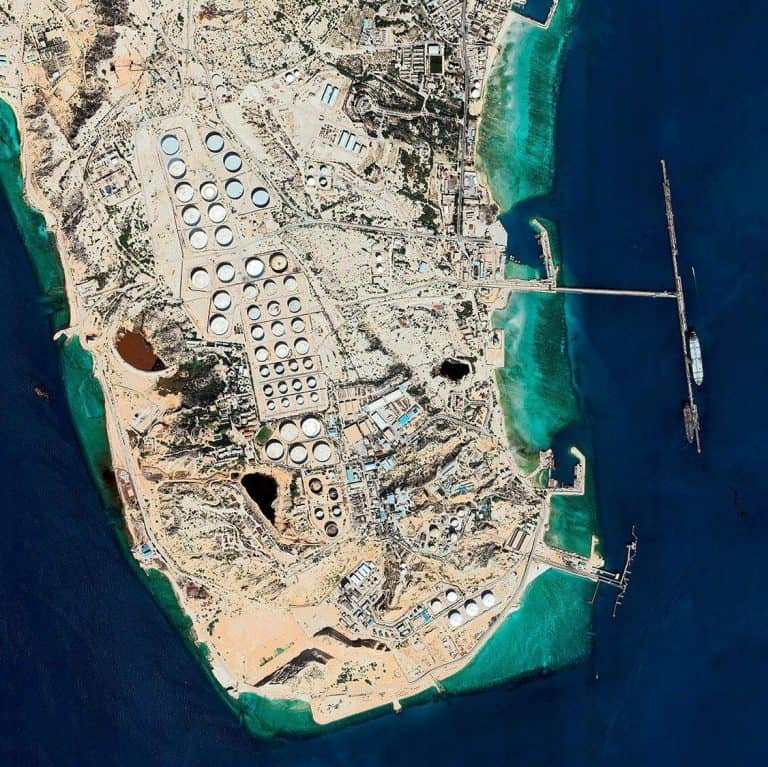
Kharg Island’s importance has always rested on a geographical joke of rather grim construction: an enormous share of Iran’s economic life has been concentrated on a very small piece of land.
Before the war, approximately 90 percent of Iran’s crude exports passed through Kharg. That made the island an efficient terminal in peacetime and a conspicuous pressure point in war.
A pipeline can be repaired. A tanker can be replaced. But a national export system concentrated around one island cannot be casually relocated when missiles begin arriving.
Kharg is therefore more than an oil terminal. It is Iran’s most valuable hostage—and Iran happens to be both the hostage-taker and the hostage’s owner.
Tehran depends on the island to sell its petroleum. Washington understands that dependence. Oil buyers understand it. Shipping companies, insurers and tanker crews understand it. Every participant may describe the situation differently, but they are all staring at the same map.
This is why threats against Kharg carry such weight. One need not occupy the island to exploit its vulnerability. It is enough to persuade captains, insurers and traders that approaching it may prove ruinously expensive.
Modern sieges do not always require walls. Sometimes they require only a risk assessment.
From War Rig to War Target
The comparison with Mad Max is no longer merely decorative.
In George Miller’s wasteland, the War Rig matters because it carries the substances upon which the remaining social order depends. It is attacked not because it is symbolic, but because it is useful. Its value creates its danger.
The same brutal logic now hangs over the Persian Gulf.
A modern tanker does not need spikes welded to its hull or armed scavengers clinging to its ladders to become a War Rig. It needs only to carry a resource valuable enough that governments will threaten, escort, blockade or destroy it.
The cinematic War Rig advertises its militarization. The modern tanker conceals its own beneath maritime paperwork, commercial ownership structures and the polite vocabulary of global trade.
Then the missiles arrive and remove the euphemisms.
The distinction between military and economic warfare has always been more comforting than convincing. If petroleum revenue helps sustain a state’s military capability, an enemy will eventually regard petroleum infrastructure as part of that capability. Once this occurs, the tanker’s civilian paint becomes a legal and moral complication—not a shield.
That complication should trouble us considerably more than it appears to trouble the men issuing communiqués.
Merchant crews are not cabinet ministers. They do not formulate blockade policy or select missile targets. Yet they are increasingly being asked to sail through the consequences of decisions made in distant rooms by people who will never smell burning fuel at sea.
The Euphemism of “Economic Cost”
The phrase “economic cost” deserves inspection.
It sounds bloodless, almost administrative. One imagines a disappointing quarterly report, an unfavorable interest rate or a sternly worded letter from an accountant.
In practice, economic warfare can mean disabled ships, evacuated crews, interrupted wages, higher food prices, fuel shortages and ordinary families discovering that a geopolitical struggle has quietly entered their monthly budget.
Oil does not remain oil for very long.
It becomes diesel for trucks, fuel for farm equipment, feedstock for manufacturing, heat for homes and transportation for nearly everything displayed on a store shelf. The price of a barrel is merely the opening sentence in a much longer invoice.
Brent crude futures closed on September 4 at $96.28 per barrel, their highest closing level since July 24, as the renewed tension intensified concerns about supply.
Meanwhile, tankers have increasingly crossed the Strait of Hormuz with their Automatic Identification System signals switched off. Goldman Sachs has estimated that actual Persian Gulf exports may be running at 15 to 16 million barrels per day, compared with visible flows of roughly 10 million.
The ships have not vanished. They have merely turned off the lights.
This is the petroleum world’s answer to coercion: secrecy, rerouting, intermediaries and a thriving market in plausible deniability. A blockade creates scarcity, but it also creates incentives. Where governments construct barriers, commerce begins searching for tunnels.
Bombing the Oil Trade to Protect the Oil Trade
The deepest absurdity is that both military coercion and maritime protection are conducted beneath the banner of stability.
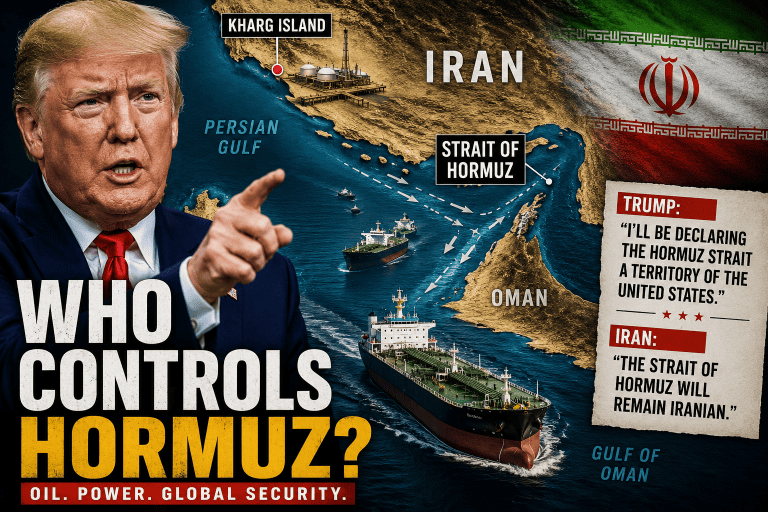
Iran asserts its power over the Strait of Hormuz because the strait provides leverage against larger adversaries. The United States deploys naval power because allowing any one state to control that passage would endanger international commerce. Each side claims to be responding to the other. Each describes escalation as deterrence.
Thus, tankers are attacked to punish attacks on ships, while warships patrol shipping lanes so that commerce may continue through a region in which the presence of warships helps make commerce dangerous.
This is not a logical circle. It is a whirlpool.
The stated objective is the uninterrupted movement of energy. The method increasingly involves missiles, blockades and the threat of further attacks against the infrastructure required to move that energy.
We are bombing the pump to save the pump.
The Island at the Center of the Argument
Kharg Island is not merely where Iran loads oil. It is where several cherished political fictions collide.
The first fiction is that markets exist independently of military power. They do not. The free movement of petroleum through contested waters ultimately depends upon ships carrying weapons.
The second is that economic warfare is clean. It is not. Its suffering is dispersed among people whose names never appear in strategic briefings.
The third is that governments control escalation. More often, governments control only their own contribution to it—and sometimes not even that.
The attack near Kharg does not necessarily mean that the island’s principal terminals will be destroyed. It does not prove that a broader campaign against Iranian oil infrastructure has begun. The available reports should be followed carefully, particularly where American and Iranian accounts diverge.
But it does represent a threshold.
The tanker has crossed from being the object everyone claims to protect into the category of things a military openly boasts of striking.
The War Rig has ceased to be a metaphor.
The Wasteland Was Always Closer Than We Thought
The most unsettling lesson of Mad Max was never that civilization might disappear overnight. It was that civilization’s machinery could survive after its moral vocabulary collapsed.
The engines still run. The fuel still moves. Leaders still issue orders. Markets still assign prices. What disappears is the respectable distance between the resource and the violence required to control it.
Kharg Island now sits inside that narrowing distance.
A tanker burns or is disabled near an oil terminal. A navy calls it economic punishment. A government calls it aggression. Traders watch the price of crude. Crews evacuate. Consumers elsewhere eventually encounter the consequences without ever learning the names of the ships involved.
And the world continues insisting that the oil merely finances the war.
It would be more accurate to say that the oil has joined it.
Sources: Reuters: U.S. strikes three Iranian oil tankers; Associated Press: Iran accuses the U.S. of targeting a tanker near Kharg Island; Financial Express: “Dark” tanker traffic surges through Hormuz.
This article contains analysis and commentary based on reports available September 5, 2026. Details may change as additional information is released.