Kharg Island Is Exporting Slogans. The Crude Is Staying Home.
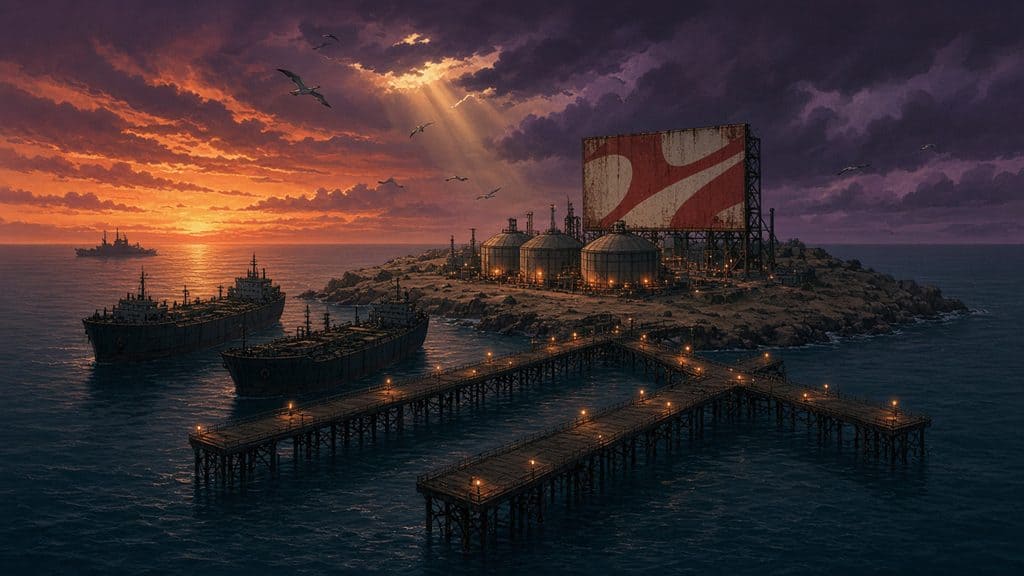
There is a kind of official sentence that can only be composed by a man confident that nobody in his audience may check it, and the managing director of the Iranian Oil Terminals Company produced a handsome specimen this week. During the 40-day war, Abbas Asadrouz told Kayhan, Kharg Island absorbed 548 strikes, “mostly by bunker-buster missiles,” and its staff still managed to export 70 million barrels; average shipments, he added, ran about 10 percent above the pre-war level. The petroleum minister, Mohsen Paknejad, had already assured the nation that crude exports “did not stop even for one hour.”
I have no wish to sneer at the men who stayed on the jetties under that bombardment; they showed more nerve than anyone who later drafted the communiqués. My quarrel is with the tense.
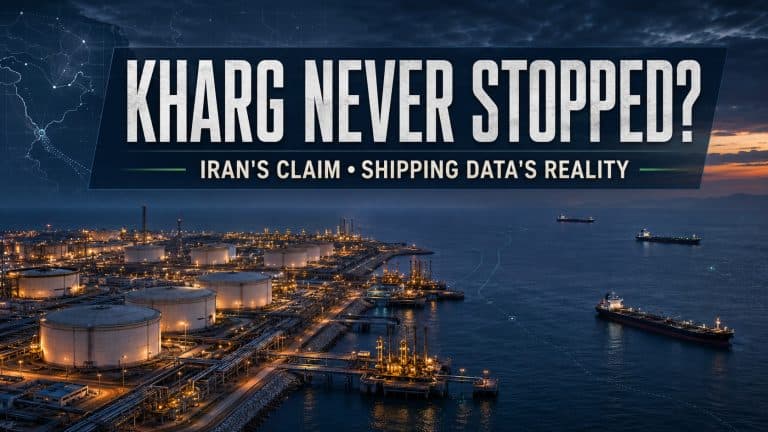
The 40-day war began with the American and Israeli strikes of February 28 and ended with the ceasefire of April 8. The boast, in other words, concerns a spring that has been dead for half a year. What has happened since is recorded by people with satellites rather than slogans. Since Washington reimposed its naval blockade on July 14, United Against Nuclear Iran has counted 38 loadings of Iranian oil and petrochemicals, of which exactly eight took place at Kharg, the terminal that, by Mr. Asadrouz’s own account, handles 93 percent of Iran’s crude. UANI has not tracked a single laden crude tanker slipping out of the Gulf of Oman since July 12. At least 53 loaded tankers lie along the Iranian coast, going nowhere at considerable expense. (UANI is an advocacy outfit with its own preferences, but its counts come with satellite images and hull numbers, which is more than Kayhan offers.)
A cargo that has been loaded but cannot sail is not an export. It is a storage tank with a bow.
The minister, to be fair, let the truth slip in the same interview: “These blockades are very difficult and have a significant impact.” It is the most useful sentence an Iranian official has uttered all autumn, and naturally it was not the headline.
An island that has heard all this before
Persian oil has always attracted confident claims. The Anglo-Persian Oil Company was built on William Knox D’Arcy’s concession of 1901, and on the eve of the First World War Churchill’s Admiralty bought a controlling stake so the Royal Navy could burn Persian crude. When Mohammad Mossadegh nationalized the industry in 1951, London and Washington answered two years later with a coup. The clerics have dined out on 1953 ever since, and they were not wrong about it, which is precisely what made the grievance so serviceable: a true complaint can be stretched to excuse almost anything, a theocracy included.
Kharg itself became the main event in the 1980s, when Saddam Hussein’s air force hit the terminal again and again and the tanker war turned the Gulf into a shooting gallery. Iran’s answer was a ruinous shuttle of tankers carrying crude down the Gulf to Sirri and later Larak, and the Iraqi aircraft followed them there too. Still, the oil got out. (Our history of Kharg in the Iran-Iraq War has the details.) The regime now commemorates that ordeal by pretending the current one is the same story. It is not. Saddam could bomb the jetties; he could not stop the ships at the mouth of the Gulf. The United States Navy can, and by UANI’s latest tally it has redirected 125 vessels and disabled three.
The strait as ransom note
Which brings us to Hormuz, now openly a bargaining chip. The deputy foreign minister, Saeed Khatibzadeh, told Russian state television, as relayed by IRNA and Anadolu, that the strait will reopen only when the United States provides “objective guarantees” to end the war on all fronts, releases frozen Iranian assets and lifts the blockade. “The ball is in the US court,” he said. Abbas Araghchi’s seven-day plan sets out the choreography: American measures in the first four or five days, the strait reopened around the sixth, talks on the seventh. Trump rejected it, Qatar kept carrying the envelopes, and according to an official briefed on the talks, the two sides now agree on the components and differ on the sequence. They agree, that is, on everything except who moves first, which is the only question there has ever been.
Then came the farce in New York. Marco Rubio ordered Araghchi’s delegation out of the country on Monday, because the Iranians, an American official told Fox News, had “overstayed their welcome.” Iran’s mission replied that the departure had been scheduled all along and that the State Department, “having achieved nothing,” had “resorted to propagating baseless and worthless news.” Each statement may well be accurate about the other.
Here is the irony the mullahs would least like advertised: the hostage keeps wandering off. Windward assesses that Iran is less able to constrain traffic in the southern corridor than it was in midsummer, and Kpler reports that Hormuz volumes excluding Iran were back to pre-war levels in September. The Islamic Republic has seized a strait and found that the one prisoner it cannot release is its own oil.
The menace is still lethal. On September 29 three Liberian-flagged tankers, the Mersin Prosperity, the Sinbad and the Al Ruwais, were struck by projectiles while running the strait with their transponders switched off. Fars put the bangs heard near Qeshm down to “warning shots,” and an IRGC spokesman repeated that ships crossing without permission would either be targeted or hit a mine. The International Maritime Organization counts 24 seafarers dead in this war at sea. Nobody asked them for their views on anyone’s sovereign rights.
Washington’s dialect
None of which entitles Washington to its current glow. Orwell observed that political language is designed “to make lies sound truthful and murder respectable, and to give an appearance of solidity to pure wind,” and the Treasury seems to have adopted the essay as a style manual. Thursday’s action, issued under the banner of “Operation Economic Outcast,” designates Iran Khodro, SAIPA and the state railway company, among others, and announces, as settled fact, that Iran’s oil revenues “fall to zero.” Zero is a press-release number, exactly as Kayhan’s 70 million is. UANI itself recorded Iranian crude being moved ship-to-ship south of Hong Kong on September 22. And a sanction on a passenger railway lands, as these things tend to, on the passengers.
Then there is the theory of decapitation. The war opened by killing Ali Khamenei. The Assembly of Experts replied by installing his son, so that a revolution made in 1979 against a hereditary monarch has now conducted its second succession and its first dynastic one. Gibbon would have recognized the maneuver. The new Supreme Leader has all but vanished from public view. Masoud Pezeshkian told CBS he is “completely healthy” and that a six-member council directs decisions, while X kills him off at intervals (the most recent viral version, in which an Emirati airstrike did the job, was false). Those who boasted of cutting off the head have produced a regime with an invisible head and a committee for a neck, which is no improvement for anyone, least of all Iranians.
Meanwhile the USS Theodore Roosevelt slipped out of San Diego on Sunday to relieve the George Washington, and the Makin Island amphibious group followed the next day. Asked by Time whether he might “annihilate Iran,” the president gave a one-word answer: “Possible.”
The peacemaker from Valdai
Into this steps Vladimir Putin, in the costume of the honest broker. At the Valdai Club he said that Russia hopes the strait reopens and sanctions on Iran are lifted, “something Tehran is rightly seeking,” and that Russia “opposes all forms of aggression.” He then added that the events in Ukraine constitute aggression by the collective West against Russia. His offer to take Iran’s enriched uranium, he noted, “remains on the table.” One would like to know what else is on that table; a government whose budget runs on crude sales is hardly a disinterested party to a crisis that keeps oil near $100.
Brent was trading around $101 on Thursday, up about $3 after Chinese refiners suspended fuel exports beyond Hong Kong and Macau. China, Tehran’s most important customer, has answered the emergency by keeping its own petrol at home, the most candid statement of priorities anyone has issued all week.
And on Kharg the tanks are full, the jetties are standing, and the men who held their posts through 548 strikes now watch laden hulls swing at anchor while their superiors write the barrels into history. Crude is heavy, and the blockade is real. A boast weighs nothing at all, which is why it remains the one Iranian export that clears the Gulf of Oman every time.