Saudi Arabia Tried to Stay Out of the War. The War Has Other Ideas.
For years, Saudi Arabia has been trying to accomplish something remarkably difficult in the Middle East: become boring.
Build the skyscrapers. Host the sporting events. Sell the oil. Build the resorts. Invite the bankers. Talk about artificial intelligence, tourism and investment rather than missiles, militias and Yemen.
It was a sensible ambition.
War, unfortunately, has never shown much respect for economic development plans.
Saudi Arabia now finds itself confronting a dangerous possibility. The expanding war surrounding Iran may be pulling the kingdom toward a conflict it has spent years trying to escape.
And this time the battlefield is not approaching from one direction.
It is approaching from several.
The Missile Over Riyadh
On September 19, Saudi Arabia said its air defenses intercepted a ballistic missile launched by Yemen’s Houthi movement toward Riyadh.
Residents reported hearing an explosion. Smoke was seen near the airport.
There were no reported casualties or damage.
That is the reassuring part.
The less reassuring part is that somebody fired a ballistic missile at the Saudi capital in the first place.
It was the first such attack on Riyadh since the latest escalation between Saudi Arabia and the Houthis, the Iranian-backed movement that controls much of Yemen.
The Houthis also claimed attacks against targets in Yanbu and elsewhere in Saudi Arabia, including facilities belonging to Saudi Aramco. Saudi authorities said several attacks were intercepted. Some of the Houthi claims have not been independently verified.
That distinction matters.
A regional war already contains enough combustible material without journalism adding gasoline of its own.
But even the confirmed events are serious enough.
Saudi Arabia is again exchanging fire with the Houthis.
And Yemen, which Riyadh has spent years trying to put behind it, is becoming a front line once more.
The War Saudi Arabia Wanted to Leave
This is where history begins collecting its debts.
Saudi Arabia intervened militarily in Yemen in 2015 after the Houthis seized Sanaa and drove the internationally recognized government from the capital.
What Riyadh initially expected to be a relatively short military campaign became an exhausting war.
Years of airstrikes did not destroy the Houthi movement.
If anything, the organization became more dangerous.
The Houthis acquired increasingly sophisticated missiles and drones, developed a larger military organization and demonstrated that Saudi Arabia’s enormous defense budget did not make its infrastructure invulnerable.
Eventually, Riyadh began searching for a way out.
For several years the Saudi-Houthi front was comparatively quiet.
Now that arrangement is coming apart.
In September, Houthi forces launched a major offensive along Yemen’s Red Sea coast, capturing territory including the strategically important port of Mocha and islands near the Bab al-Mandeb Strait. Saudi-backed Yemeni forces retreated from several positions.
Saudi aircraft have returned to striking Houthi positions.
The Houthis have returned to firing missiles and drones toward Saudi Arabia.
A war Riyadh had hoped to place in the archives has climbed back onto the desk.
Then Someone Hit the Pipeline
If Yemen were the only problem, the situation would already be serious.
It isn’t.
On September 11, drone attacks struck Saudi Arabia’s East-West oil pipeline.
The pipeline stretches roughly 1,200 kilometers across the kingdom, carrying crude from the country’s eastern oil fields toward the Red Sea port of Yanbu.
Its strategic purpose has suddenly become extraordinarily important.
It allows Saudi Arabia to move enormous quantities of oil without sending them through the Strait of Hormuz.
That is rather useful when the Strait of Hormuz is sitting in the middle of a war involving Iran.
Saudi Arabia temporarily shut the pipeline after the attack. Iraqi authorities opened an investigation after indications that drones involved in the strike came from Iraqi territory. No organization initially claimed responsibility for the attack.
And here the geography becomes almost cruel.
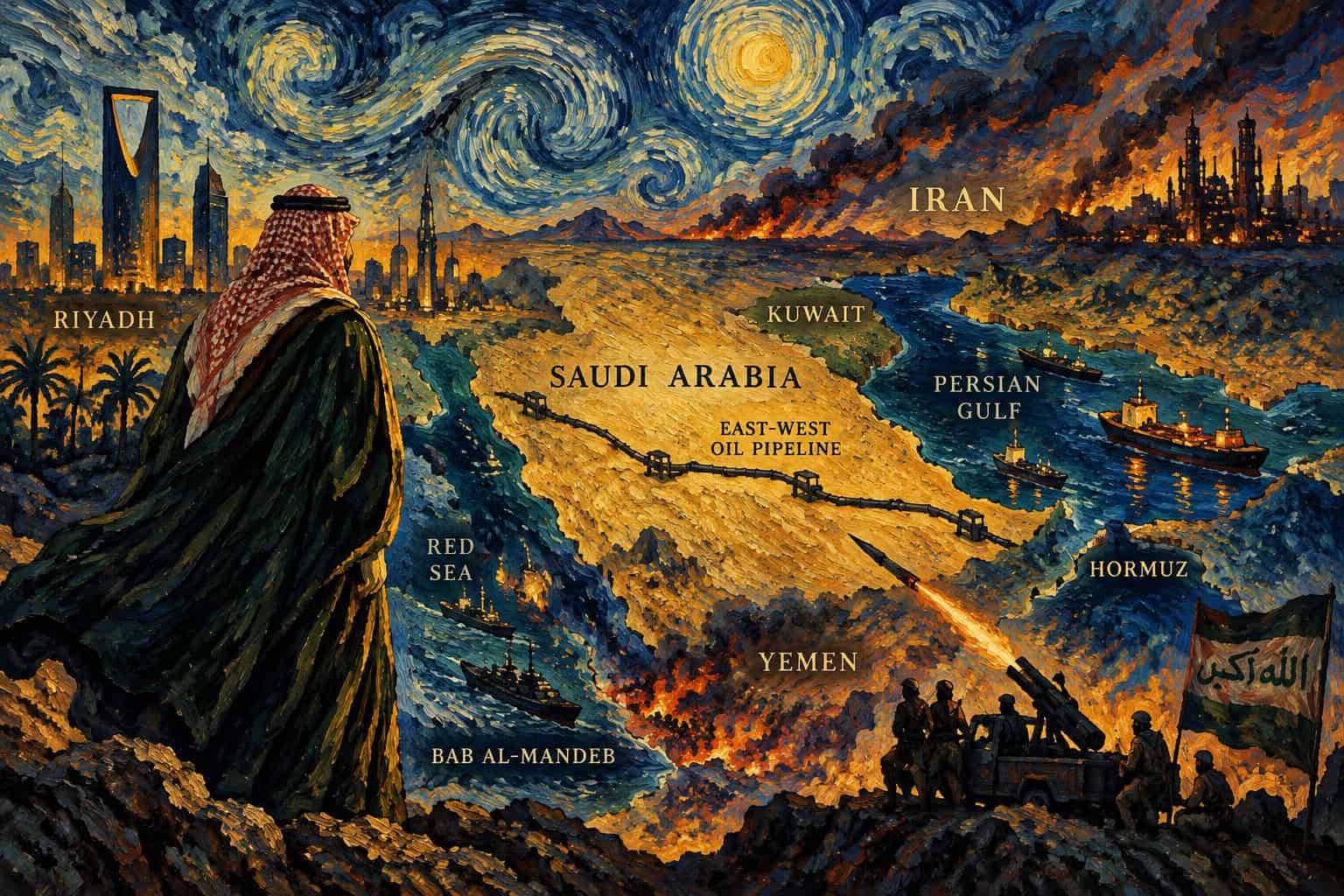
Look at a map.
To Saudi Arabia’s east sits the Persian Gulf and the Strait of Hormuz.
To its southwest sits Yemen and the Bab al-Mandeb.
Running across the country between them is the East-West pipeline.
These are not merely dots on a map.
They are arteries of the global economy.
And all three are now under pressure.
The Kingdom’s Escape Route Has an Escape Route
Saudi Arabia built its oil infrastructure with precisely this kind of strategic problem in mind.
If Hormuz became dangerous, oil could travel west through the pipeline to Yanbu.
Elegant.
Until the pipeline itself became a target.
Following the disruption, Saudi Arabia began moving considerably more oil through Hormuz again. Satellite data cited by JPMorgan analysts indicated Saudi crude moving through the strait averaged about 2.9 million barrels per day over a recent six-day period, compared with roughly 700,000 barrels per day in August.
Think about the irony.
The alternative route designed to reduce Saudi dependence on Hormuz was damaged, pushing Saudi oil back toward Hormuz.
Meanwhile, Houthi advances have increased pressure around Bab al-Mandeb, the maritime gateway connecting the Red Sea with the Gulf of Aden.
The kingdom therefore faces an uncomfortable strategic geometry.
Hormuz matters.
Yanbu matters.
Bab al-Mandeb matters.
Yemen matters.
And suddenly Saudi Arabia’s ability to remain detached from the wider war matters enormously.
This Does Not Mean Saudi Arabia Wants War With Iran
Here we should resist the intoxicating temptation to make the story simpler than it is.
Saudi Arabia does not appear eager for a direct war with Iran.
Quite the opposite.
The two countries restored diplomatic relations in 2023 after years of hostility. Riyadh has spent considerable political energy attempting to reduce tensions with Tehran.
Even amid the current fighting, Gulf governments have been discussing ways to rebuild a regional security dialogue with Iran.
Saudi Arabia has reportedly explored the possibility of a non-aggression arrangement with Tehran, while Qatar and the United Arab Emirates have publicly advocated renewed regional dialogue.
That tells us something important.
The Gulf states understand what outsiders occasionally forget.
They actually have to live here after everybody else’s aircraft carriers go home.
Saudi Arabia can oppose Iranian influence, fight an Iranian-backed movement in Yemen, intercept missiles and defend its oil infrastructure while simultaneously believing that a direct Saudi-Iranian war would be catastrophic.
Those positions are not contradictory.
They are the mathematics of survival.
Iran Has Its Own Calculation
Iran also faces choices.
Supporting allied armed groups gives Tehran influence far beyond Iran’s borders without requiring Iranian forces to fight every battle directly.
But influence is not the same thing as control.
The Houthis have their own leadership, political interests and military objectives. Calling them simply Iranian puppets obscures an important distinction.
Iran provides support and maintains a close relationship with the movement.
That does not mean Tehran necessarily dictates every Houthi decision.
This distinction becomes enormously important when missiles begin flying toward Riyadh.
Because Saudi leaders must decide whether an attack by an Iranian-backed organization should be treated as an attack by that organization alone or as part of a broader Iranian strategy.
That is not merely a semantic question.
People can die depending upon the answer.
China Has Entered the Conversation
There is another player worth watching.
China.
Saudi Arabia reportedly appealed to Beijing following the recent attacks, and Reuters reported that China subsequently asked Iran to help restrain the Houthis.
This deserves considerably more attention than it has received.
China buys enormous quantities of Gulf energy.
It maintains important relations with Saudi Arabia.
It maintains important relations with Iran.
And Beijing helped broker the 2023 restoration of diplomatic relations between Riyadh and Tehran.
China therefore occupies an unusual position.
Washington possesses overwhelming military power in the region.
Beijing possesses relationships.
In a crisis, both can matter.
If China can persuade Tehran to pressure the Houthis toward restraint, Beijing strengthens its argument that Chinese influence in the Middle East can accomplish something American aircraft and missiles sometimes cannot: persuasion.
Whether Iran can or will deliver such restraint is another question entirely.
Mohammed bin Salman Has a Much Bigger Problem Than Yemen
For Crown Prince Mohammed bin Salman, war presents another danger.
It threatens the Saudi economic transformation itself.
Vision 2030 depends upon convincing investors, tourists, businesses and financial institutions that Saudi Arabia represents the future rather than another battlefield of the Middle East.
That project requires stability.
It requires airports that operate normally.
It requires oil infrastructure that works.
It requires shipping lanes that remain open.
And it certainly benefits from ballistic missiles not being fired toward Riyadh.
Saudi Arabia has spent staggering sums building an economy intended eventually to depend less upon petroleum.
The paradox is deliciously unpleasant: oil revenue is financing the attempt to escape dependence on oil, while attacks on oil infrastructure threaten the stability necessary to accomplish the escape.
History has a dark sense of humor.
What Would Actually Pull Saudi Arabia Deeper Into the War?
There probably will not be a single cinematic moment in which Saudi Arabia announces that it has “entered the war.”
Wars rarely behave so politely.
Saudi involvement is more likely to deepen incrementally.
Another missile attack.
Another drone strike.
Another damaged pipeline.
Another Saudi airstrike in Yemen.
Another Houthi retaliation.
Another attack on an airport, refinery or oil terminal.
Each action can be described as retaliation for the previous one.
And eventually historians draw a line backward through the events and announce that a war began somewhere along it.
Saudi Arabia is already conducting military operations connected to the renewed fighting in Yemen. Reuters reported this week that Saudi-backed forces acknowledged air operations against Houthi positions, while Houthi missiles and drones have repeatedly targeted Saudi territory.
The question is therefore not simply whether Saudi Arabia “joins” the wider war.
The more useful question is whether the boundaries between the Yemen conflict, the Iran conflict and the struggle over Gulf energy infrastructure continue to disappear.
They increasingly appear to be doing so.
And This Brings Us Back to Kharg Island
Kharg Island sits hundreds of kilometers away from Riyadh.
Yet the two are connected by something stronger than geography.
Oil.
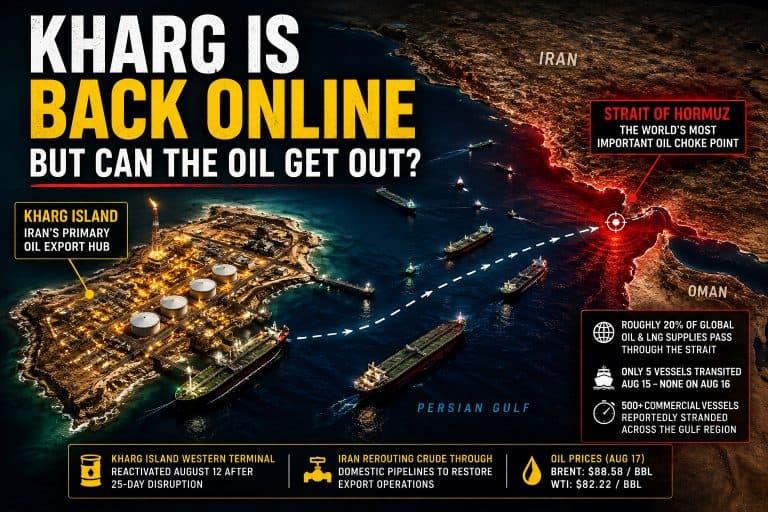
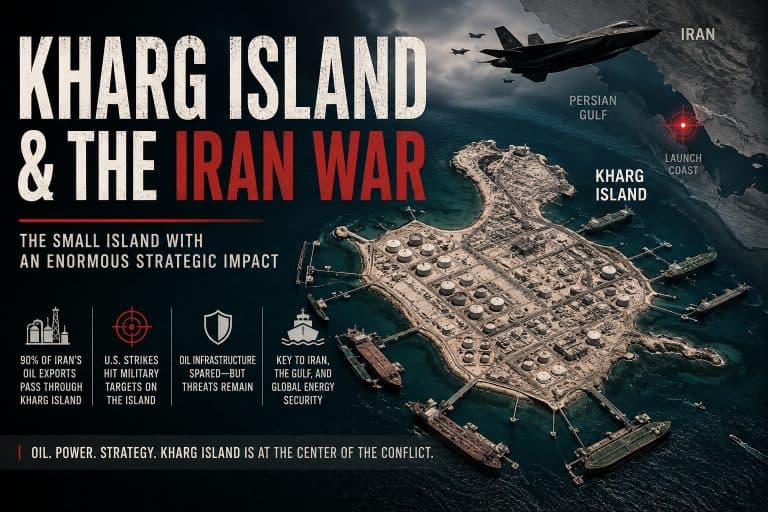
Kharg is the beating heart of Iran’s crude-export system.
Saudi Arabia possesses the world’s most important competing petroleum infrastructure across the Persian Gulf.
Between them sits Hormuz.
To the west sits Yanbu.
Below them sits Bab al-Mandeb.
These places form a system.
Damage one part and tankers move somewhere else.
Close one route and another becomes more valuable.
Attack the alternative route and ships return toward the danger they were attempting to avoid.
This is why Kharg Island cannot be understood by staring only at Kharg Island.
To understand the island, you must understand Riyadh.
You must understand Yemen.
You must understand Hormuz.
You must understand China.
You must understand Washington.
And increasingly, you must understand the narrow waterways through which the modern world quietly moves the substance upon which much of its economy still depends.
The Most Dangerous Possibility
The most dangerous scenario may not be that Saudi Arabia decides it wants a war with Iran.
There is little evidence that it does.
The more dangerous possibility is that nobody particularly wants a larger war and nevertheless constructs one.
A Houthi commander launches a missile.
Saudi Arabia retaliates.
Another militia attacks Saudi infrastructure.
Riyadh responds again.
Iran increases support.
Washington increases support for Riyadh.
Someone misidentifies the origin of a drone.
Someone kills the wrong people.
Someone decides that failing to retaliate looks weaker than retaliating.
This is how governments become prisoners of events they once believed they controlled.
For now, diplomacy remains alive. Gulf governments are openly discussing renewed dialogue with Tehran, and Washington and Tehran continue signaling at least some interest in finding a diplomatic path even while exchanging threats.
That should not be dismissed as theater.
Diplomacy is often conducted precisely when the alternative has become intolerable.
Saudi Arabia spent years trying to get out of Yemen.
It spent years repairing its relationship with Iran.
It spent billions trying to convince the world that its future would be defined by investment rather than conflict.
Now missiles are again flying toward Riyadh.
Its western oil artery has been attacked.
The Houthis are advancing.
And the kingdom finds itself staring at the oldest question in geopolitics:
What happens when a country that does not want a war discovers that the war has arrived anyway?